Conventional objects and effects
Some disc-like reports are balloons, aircraft, clouds, optical effects or fabricated images. Resolved controls establish these mechanisms, but do not identify every superficially similar report.
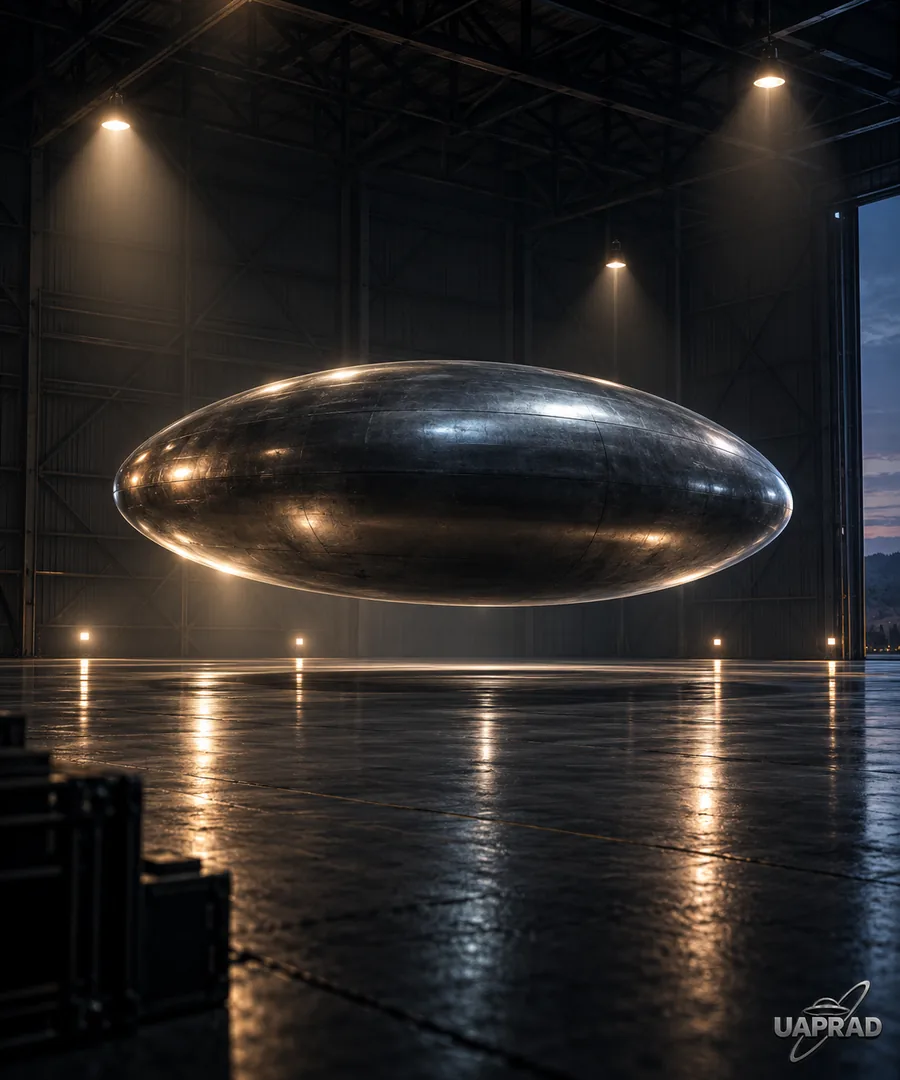
Disc and saucer reports describe circular or flattened forms, sometimes with a dome, rim or lens-like profile. The sources range from close visual accounts to photographs and distant lights. HANGAR compares their reported appearance and the evidence supporting each description.
Selected records describe reported appearances. Cross-listing one event under several forms adds no independent observation.
The catalogue distinguishes a detailed witness description, an inferred outline and a camera or sensor image. Morphology confidence concerns the shape supported by that evidence; physical-form confidence concerns whether a bounded body is supported. A detailed description can retain uncertain range and identity.
| Case | 11 May 1950 · Near Sheridan, Oregon, United StatesMcMinnville photographsUnresolvedFormal photographic case study | 5 or 15 August 1950 · Great Falls, Montana, United StatesGreat Falls filmUnresolvedFormal photographic case study | 14 July 1952 · Near Norfolk, Virginia, United StatesNash–Fortenberry sightingUnresolvedContemporary official correspondence |
|---|---|---|---|
| Summary | Evelyn and Paul Trent reported a slow-moving metallic object above their farm, and Paul made two photographs. The images preserve a distinct asymmetric disc-like outline, but contain no independent scale or range reference. Technical studies divide principally between a distant object and a small suspended model. | Nick Mariana and his secretary reported two bright objects, and Mariana recorded about 16 seconds of 16 mm film. His early description called them disc-shaped lights, but the surviving film mainly resolves bright sources. The Colorado study found aircraft difficult, though not impossible, to reconcile with the sequence and left the case unexplained. | Pan American pilots William Nash and William Fortenberry reported six glowing, disc-shaped objects passing below their DC-4 and reversing their order during a rapid turn. Project Blue Book told Nash in July 1953 that the report remained unsolved. No photograph or radar record fixes range, dimensions or velocity. |
| Core evidence |
|
|
|
| Finding | The photographs provide a clear disc-like image, but their scale remains the central unresolved issue. | The film records movement more clearly than shape; the disc description rests mainly on witness testimony. | Two pilots gave a consistent account of six disc-like forms, while all dimensions and speeds remain visual estimates. |
| Case | 26–27 June 1959 · Boianai, Papua New GuineaFather Gill sightingsUnresolvedNear-contemporary government file | 24 April 1964 · Socorro, New Mexico, United StatesSocorro incidentUnresolvedContemporary government case file | 6 April 1966 · Clayton South, Victoria, AustraliaWestall school incidentInsufficient dataInstitutional historical account |
|---|---|---|---|
| Summary | William Booth Gill and groups of mission witnesses described a large circular or platform-like object with a narrower upper section, apparent legs and figures. Gill made notes and sketches close to the observations and supporting statements were signed, but no image, radar record or physical trace establishes range or structure. | Police officer Lonnie Zamora reported a white, egg-shaped object on apparent supports, with two small figures and a red marking, then flame, a roar and a rapid departure. The UAPRAD witness record preserves that oval description. He sketched the marking. Project Blue Book left the case unidentified. The same-day ground depressions record the site. The outline remains his description. The report stays linked to discs because later summaries sometimes flatten the egg into a saucer. | Students and at least one teacher reported one or more silver, grey or white disc-like objects in daylight. Contemporary reporting and Andrew Greenwood's near-contemporary account establish a significant sighting, but later claims of a landing, trace and official suppression exceed the early documentary record. |
| Core evidence |
|
|
|
| Finding | Prompt notes, sketches and signed statements preserve a detailed circular form; range and scale remain witness estimates. | The close-range description is an egg-shaped body. The same-day marks do not supply that outline, and Blue Book’s unidentified conclusion leaves the identity open. | Early sources support a daylight disc report; the landing and suppression narratives developed later. |
| Case | 20 May 1967 · Near Falcon Lake, Manitoba, CanadaFalcon Lake incidentUnresolvedGovernment archival account and records guide | 8 January 1981 · Trans-en-Provence, Var, FranceTrans-en-ProvenceUnresolvedPrimary official technical report | 7 November 2006 · Chicago, Illinois, United StatesO’Hare Airport sightingInsufficient dataAviation-safety case study |
|---|---|---|---|
| Summary | Stefan Michalak reported two reddish objects, one of which descended nearby and appeared as a metallic disc or oval with an upper dome. Medical records documented burns and illness after the encounter, while Canadian agencies investigated damaged clothing and later site-associated samples. The physical aftermath is documented more securely than its connection to the object because Michalak was the sole direct witness and the site and samples lacked continuous independent custody. | Renato Nicolai reported a small grey disc-like object with an equatorial band and apparent skids descending onto a terrace before departing. Gendarmes documented a circular ground trace the next day, and GEPAN coordinated soil and vegetation analysis. The prompt official work provides substantial trace evidence, but the object itself rests on a single visual account and ordinary mechanical causes remain relevant to the accessible site. | United Airlines employees reported a dark, sharply defined disc below low cloud near Gate C17 and described a rapid upward departure. Airline and Federal Aviation Administration communications establish that reports were made, but no authenticated image or public radar track resolves the object. A fallstreak hole is a strong explanation for the reported cloud opening, not necessarily for the preceding disc description. |
| Core evidence |
|
|
|
| Finding | The case joins a detailed disc-or-oval description to a documented medical aftermath, with the connection dependent on one direct witness. | Prompt official sampling makes the ground trace unusually well documented; the reported object remains a single-witness observation. | Several aviation witnesses described a disc below cloud; their accounts and the institutional communications form the surviving evidence. |
| Case | 17 August 1958 · Warren, Michigan, United StatesWarren daylight reportUnresolvedNational Archives case-file reproduction |
|---|---|
| Summary | A civilian observer using field glasses described a bright circular grey-white form with concentric detail. As it rotated and departed, he reported an elongated, centrally raised profile. Project Blue Book left the case unidentified. The changing appearance makes it useful for studying viewing aspect and cross-category assignment, but the single account supplies no measured range or image. |
| Core evidence |
|
| Finding | The reported change from round to elongated shows how viewing angle can move one observation between shape categories. |
The disc category connects two different evidential achievements: a camera can preserve a clear outline, and a witness can describe a body with features absent from the surviving imagery. McMinnville supplies the former; the close accounts at Socorro, Falcon Lake and Trans-en-Provence supply the latter. Neither route, on its own, fixes range or links a reported body to an independently identified object.
The photographic dispute turns on assumptions that alter the distance estimate, rather than on the simple presence of a disc-like image. Physical-trace investigations pose a separate causal question. Prompt documentation increases confidence that an aftermath was recorded, while the association between that aftermath and the reported body still requires evidence. Combining those records cannot repair the missing range in a photograph or supply an independent view of a landing.
A common disc design would require agreement on more than the broad outline. The selected reports differ in surface detail, motion and observation conditions, and several cross into oval or round categories. The catalogue consequently supports a history of recurring descriptions and specific unresolved cases. Its most useful comparisons concern how each description was obtained and what additional evidence could discriminate between the competing interpretations.
The tiers describe each source’s relationship to the record. Direct testimony can remain uncorroborated, and an official document can preserve a claim without verifying its physical interpretation.