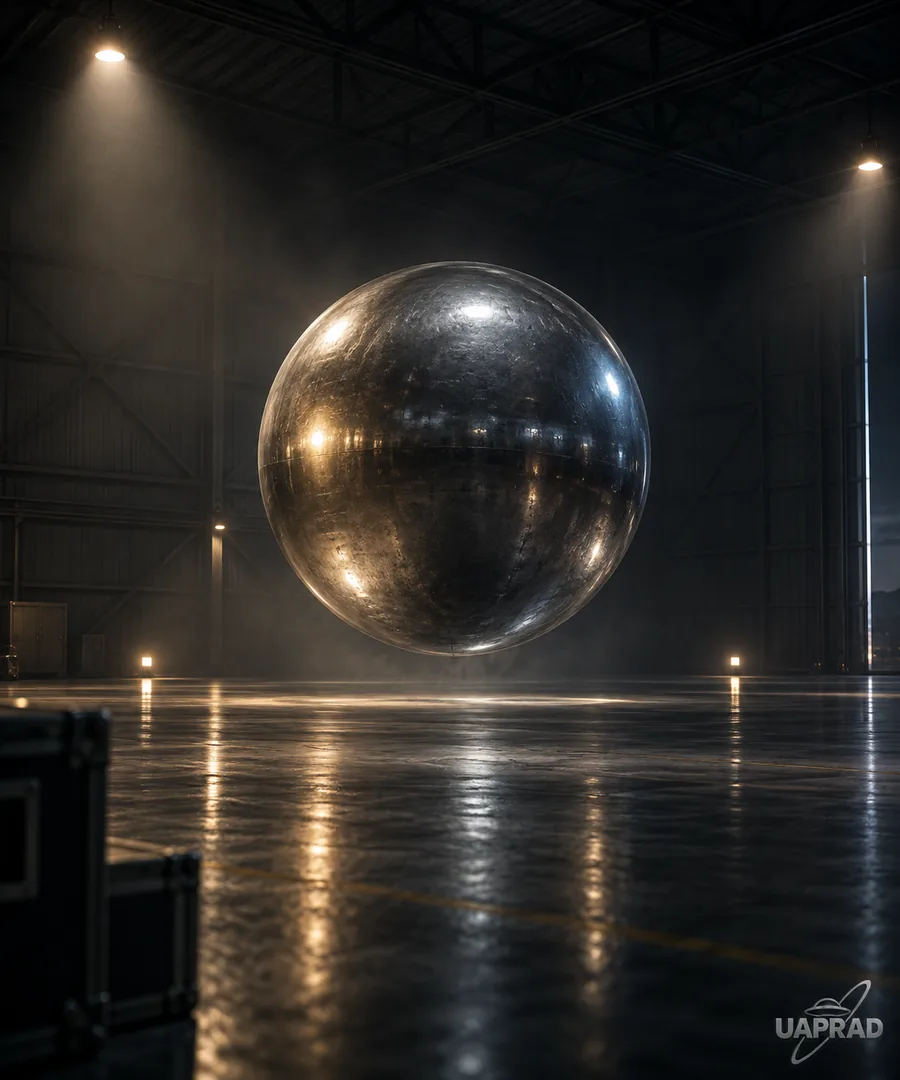
Some reports describe an object changing shape; others show only a changing image. Orientation, focus, glare, sensor mode and compression can alter appearance without a physical transformation.
Changes in appearance
The category contains two distinct observations: an irregular form and a form reported to change. An irregular image recorded for a short interval need not show a transformation. A changing outline may instead reflect rotation, changing contrast or altered focus. The analysis must identify the feature that changed before selecting an explanation.
PR32’s release describes an irregular contrast area resembling part of an oval. PR33 describes short-lived irregular overlays and records a reported glare halo. Their official hosting preserves the released descriptions and media; those descriptive terms do not constitute a finding that a physical object changed shape. DOW-UAP-PR33, Syria
Continuity in the released record
PR33’s description places the irregular features within a five-second recording and cautions that the narrative is informational rather than an investigative conclusion. Such brevity limits comparisons of a stable target boundary. The possible relationship between the features, the background and the reported glare requires examination of the native frames and recording system. PR33 release (Video description, 00:01–00:03)
The Ministry of Defence log entries preserve changes in reported light or configuration, but omit the measurements needed to distinguish a physical alteration from changing appearance. A description moving from round to elliptical is compatible with a change in orientation; that geometrical possibility still requires case-specific evidence before it becomes an explanation.
Physical transformation and image formation
Evidence for physical transformation would require continuity of the same target and a boundary change that survives checks of viewing angle and recording behaviour. If tracking is lost or different bright regions dominate successive frames, apparent continuity becomes an assumption. The release of a sequence makes that question inspectable without automatically resolving it.
A useful comparison therefore follows individual features over time and asks which remain stable as the image changes. This gives irregularity an analytical role without treating it as an intrinsic property of a vehicle. At present, the selected releases support investigation of image formation more directly than a claim of material transformation.
Report catalogue
Selected records describe reported appearances. Cross-listing one event under several forms adds no independent observation.
October 2024 · Syria
DOW-UAP-PR33, Syria
The mission report described a misshapen, uneven ball of white light. AARO's video narrative records two short-lived, semi-transparent irregular areas and notes a reported glare halo.
Evidence
Released infrared image and descriptive metadata
Morphology confidence
Moderate for image appearance; low for physical change
AARO described an irregular area of colour and brightness resembling a bisected half-oval. The image is unresolved and shows no clear physical structure.
Evidence
Released infrared image and descriptive metadata
Morphology confidence
Moderate for image appearance; low for physical change
The log records a pulsing light changing shape near Beeston on 16 April, a round-to-elliptical change at Glasgow on 8 May, a cluster changing from triangular forms to crosses at Salisbury on 27 July and several objects changing shape at Basildon on 10 September. The brief descriptions give no basis for deciding whether any source physically changed shape.
The released records preserve irregular appearances and reports of changing light or configuration. The physical interpretation depends on continuity: the same target boundary must be followed through the sequence before its alteration can be measured. Brief overlays and intake summaries supply limited support for that task.
A transformation claim also needs separation of target motion from boundary change. Rotation can expose a different outline, and altered contrast can make part of a boundary disappear without a change in the body. Following identifiable features across native frames would help test those alternatives; preserving recording settings would help assess instrument effects. PR32 and PR33 should therefore be compared by what each sequence permits an analyst to track, rather than treated as corroborating examples merely because both release descriptions use irregular language.
The available descriptions consequently justify an irregular-image category more securely than a class of transforming objects. Sensor effects and changing viewpoint are hypotheses to be tested against the native record. Treating every unexplained frame as a material change would replace the missing measurement with an assumption.
Research gaps
Native PR32 and PR33 frames, recording metadata and evidence of target continuity.
Contemporaneous statements underlying the changing-shape entries in the Ministry of Defence logs.
The tiers describe each source’s relationship to the record. Direct testimony can remain uncorroborated, and an official document can preserve a claim without verifying its physical interpretation.