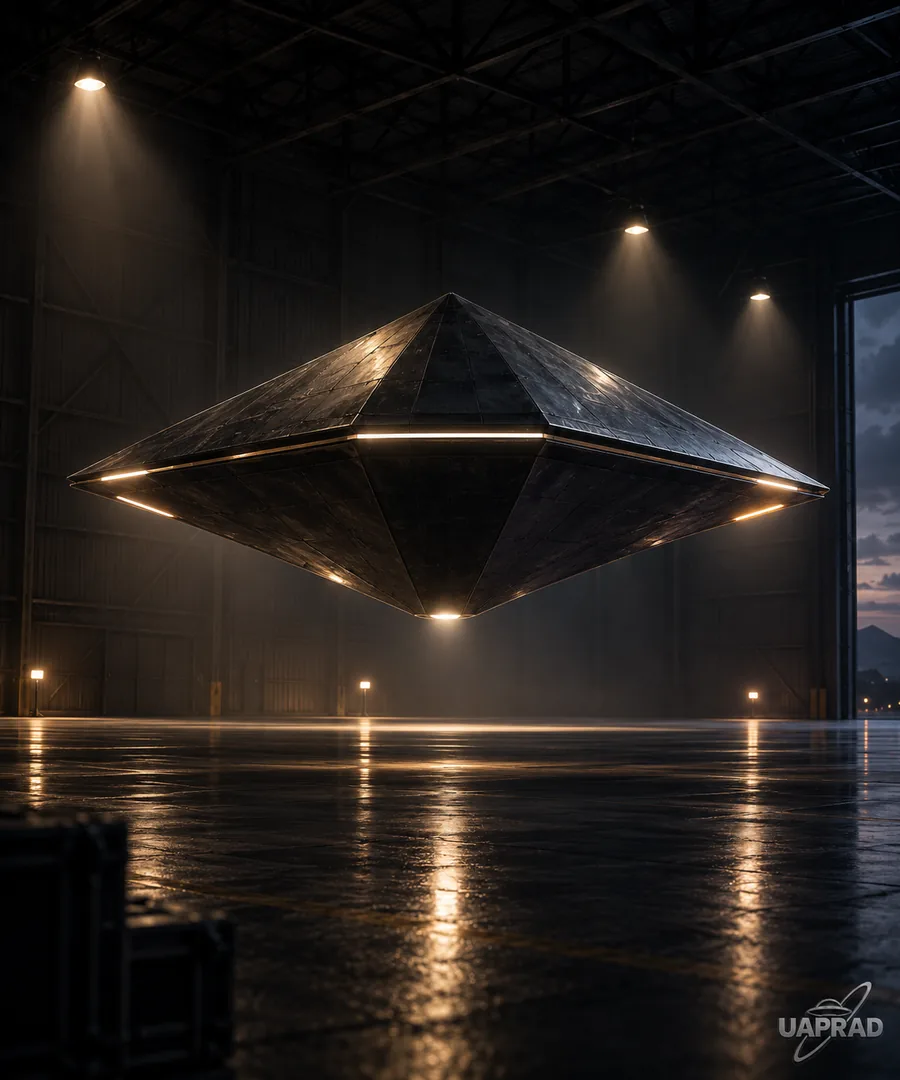
Boomerang / chevron

Overview

Boomerang and chevron reports describe an open, swept or V-shaped profile. The category includes a daylight drawing of a thin form, night-time V formations of lights, and displays later folded into those stories. A closed triangle with a described surface stays with the triangle category unless the source itself also uses boomerang or crescent wording.

Reporting history

Reported descriptions

Arnold, flying alone, reported nine bright objects in a chain north of Mount Rainier. Straight and level, he wrote, they were a thin black line. When the Sun flashed they looked completely round. The drawing caption says they seemed longer than wide, with a thickness about one-twentieth of their width. The UAPRAD witness record describes that drawing as a rounded leading edge with a rear indentation, and records the 26 June radio interview comparing the form with a pie plate cut in half and a convex triangular rear. He also compared their apparent width with the outer engines of a DC-4. The chain is nine objects, not one boomerang. The speed he calculated, about 1,200 miles per hour, depends on the path he assumed between Mount Rainier and Mount Adams.

The Times summarised the 1984 Hudson Valley reports as usually a V or a circle, about the size of a football field, noiseless, and outlined in white, red or green lights. In that article William Pollard described a gigantic triangle that hovered and then climbed, and later said the formation aircraft were nothing like that first sighting. Irene Lunn described an L-shaped arrangement that stopped over a house.

At Phoenix, the UAPRAD case record places a moving V, arc or boomerang between roughly 7:55 and 8:45 p.m., along an aviation corridor. Some witnesses reported separate lights or changing spacing. An amateur astronomer reported resolving individual aircraft through a telescope. Tim Ley’s witness page is one sustained account of that earlier passage.

Historical development

The early record is Arnold’s report of 24 June 1947 and the drawing he submitted to Army Air Forces intelligence on 12 July. The press turned a skipping-motion comparison into the flying-saucer label. That label is a different shape claim from the thin outline in the drawing. Later retellings sometimes call the objects a crescent or a boomerang. Those words are not in the July report. Kenneth Arnold’s written report and drawing

Large night formations gave the category its later public form. The Times account of 25 August 1984 is the contemporary Hudson Valley record used here. The Phoenix case, on 13 March 1997, split in public memory: video of a later light display was widely treated as a picture of an earlier moving V. The UAPRAD case record keeps those phases apart. Governor Symington’s 2007 account sits below the March reporting.

Contemporary reporting

The AARO comparison figures recorded on 14 September 2026 list 3 reports under ‘Vector/Boomerang’, representing 0.5 per cent of entries with recorded morphology for 1 January 1996–15 August 2026. The denominator concerns reports with shape information, rather than all reports or a population of identified objects. Case-level records are needed to compare those labels with the historical examples discussed here. AARO reporting table

Report catalogue

Selected records describe reported appearances. Cross-listing one event under several forms adds no independent observation.

A report belongs here when the source describes a swept, crescent, V-shaped or chevron profile, whether as one body or as lights taken for one body. A closed triangle stays with the triangle category unless the same source also uses boomerang or crescent wording. A row of lights is listed when a swept-form story has absorbed it and the record can separate the two.

Boomerang / chevron report catalogue

3 records
Case24 June 1947 · Near Mount Rainier, Washington, United StatesKenneth Arnold chain near Mount RainierUnresolvedContemporary witness record23 June 1957 · Carmichael, California, United StatesCarmichael delta-form reportUnresolvedArchival reproduction of official case recordsSummer 1984 · Northern Westchester, Dutchess and Putnam counties, New York, and western Connecticut, United StatesHudson Valley V-shaped light reportsPartially explainedContemporary news report of a state-police statement
SummaryKenneth Arnold, flying alone, reported nine bright objects in a chain north of Mount Rainier. In the written report and drawing he submitted on 12 July 1947, a level view was a thin black line and a sun flash looked completely round. He also uses saucer-like wording. The drawing caption says the objects seemed longer than wide, with a thickness about one-twentieth of their width. The July report does not use boomerang, chevron or crescent. The UAPRAD witness record describes the drawing as a rounded leading edge with a rear indentation, and records the 26 June radio interview comparing the form with a pie plate cut in half and a convex triangular rear. His speed, about 1,200 miles per hour, depends on the path he assumed between the peaks.A witness described a dark delta or boomerang-like form crossing the sky. Project Blue Book preserved the account and drawing. The brief observation contains no measured scale or reliable three-dimensional detail.On 25 August 1984 the New York Times reported a summer of strange objects over the Hudson Valley and western Connecticut, usually a V or a circle, about the size of a football field, noiseless, and outlined in white, red or green lights. The state police called the object five or six small planes in a tight formation. Sgt Kenneth V. Spiro of Troop K said a trooper tracked one formation to Stormville Airport, where light planes flew with black-painted undersides and lights that changed colour and gave the shape. He did not name the trooper or the pilots. In the same article, William Pollard described a rigid triangle that hovered and climbed, and said the formation aircraft were nothing like that first sighting. Irene Lunn described an L-shaped arrangement over a house. The UAPRAD case record places this summer in a longer 1982–1986 series.
Core evidence
Morphology confidence
Moderate
Physical form
Indeterminate
Form
Thin form, longer than wide; round in a sun flash; saucer-like wording also used
Movement
Chain of nine, timed from Mount Rainier to Mount Adams; speed depends on the assumed path
Evidence
Prompt radio interview, July written report and drawing
Limits
One witness; distance estimated; shape words in the report are mixed
Morphology confidence
Moderate
Physical form
Indeterminate
Form
Dark delta or boomerang-like outline
Movement
Rapid transit
Evidence
Witness account, drawing and Project Blue Book material
Limits
Early documented form; one viewpoint and unmeasured range
Morphology confidence
Moderate
Physical form
Formation in the followed case; residual unmeasured
Form
Usually a V or a circle of lights; individual witnesses also said triangle or L-shape
Movement
Slow or hovering appearance; one witness reported a vertical climb
Evidence
Times interviews and a named state-police sergeant
Limits
One followed formation identified; pilot and trooper names withheld; other sightings disputed
Finding

The July drawing records a thin form, longer than wide, from a chain of nine objects. The boomerang label describes that drawing. It is not Arnold’s word, and the same report includes a round flash and saucer-like comparisons.

The drawing preserves an early delta-like outline from one brief observation; scale relies on the witness estimate.

A named state-police sergeant told the Times that a trooper followed one light formation to aircraft at Stormville Airport. Witnesses in the same article distinguish other sightings from those aircraft, so the formation account covers the followed flights and leaves a residual.

Evidence

Images and video

Arnold’s July drawing is the prompt image in this selection. There is no photograph of the nine objects. The Times notes that Hudson Valley residents were bringing pictures to a photo shop in 1984. Those frames are not examined here.

The Phoenix videotapes that aired in 1997 show the later lights. Capt. Drew Sullins tied that light show to flares. The frames are not a picture of a swept body. The UAPRAD case record says video of the later display became merged with drawings of the earlier formation. The drawing at the top of this page is a UAPRAD illustration of the reported form.

Sensor evidence

The reports rely on different forms of location evidence. Arnold timed the apparent passage against an assumed mountain route. The Hudson Valley police statement concerns a formation followed to an airfield. The Phoenix flare account supplies a military explanation of the later light display. None is a calibrated measurement of a swept body, and evidence about one sequence cannot determine the identity of another.

Recurring characteristics

Within the night reports, the repeated features are a V or swept outline made of lights, little or no reported sound, and a large apparent size. A loose formation of lit aircraft can present each of those features. A continuous dark surface is claimed in some accounts and absent from others.

Arnold is the daylight exception: nine separate objects, a thin outline against snow, and a chain rather than one chevron. Repetition of a swept silhouette across interviews is not a second sighting.

Identification and interpretation

Identification problems

Several aircraft, with lights and dark undersides, can be read as one rigid shape. The Stormville account is the worked example. Spiro told the Times that the undersides and the area under the wings were painted black, and that the lights gave the shape. The state police described five or six small planes in a tight formation. Witnesses in the same article, including Pollard, said they had seen those aircraft and had also seen something they distinguished from them. A formation account covers the flights that were followed. It does not automatically cover every residual.

Visual completion can supply an edge between separated lights, and a light without a stable reference can appear to move. Those mechanisms have to be tested against each account. At Phoenix, a bright recording of one phase was later remembered as the shape of the other. The two phases do not share a time or a motion.

Resolved and explained controls

These comparisons preserve the specific mechanism and confidence of each identification.

Boomerang / chevron resolved and explained controls

1 record
Case13 March 1997 · Southwest of Phoenix, Arizona, United StatesPhoenix videotaped light displayPlausibly explainedContemporary news report of a military statement
SummaryIn a 26 July 1997 Associated Press report, Capt. Drew Sullins of the Maryland Air National Guard said eight A-10s flew training missions on 13 March over the Barry M. Goldwater Range, 60 miles southwest of Phoenix. They dropped high-intensity flares from 15,000 feet, then dumped the remaining flares at high altitude before returning to Davis-Monthan Air Force Base. Sullins said a pilot called it “one hell of a light show.” The report connects that display with lights captured on videotape. It also says the flare account leaves sightings from northwestern Arizona, up to 200 miles away, unexplained. The UAPRAD case record places this statement against the later, stationary lights and keeps the earlier moving V separate. The row is listed here because those later lights were absorbed into the boomerang story.
Core evidence
Morphology confidence
Low
Physical form
No bounded body
Form
Videotaped lights; no swept body in this statement
Movement
Dropped from 15,000 feet, then dumped at high altitude
Evidence
Named Maryland Air National Guard spokesman, July 1997
Limits
The report leaves northwestern sightings outside the flare account and does not describe the earlier moving V
Finding

Sullins’s statement attributes the videotaped lights to flares dropped and then dumped by Maryland Air National Guard A-10s. The same report leaves northwestern Arizona sightings outside that account, and it does not describe the earlier moving V.

Research and analysis

The central classification problem is whether a swept outline belongs to an individual object or to the arrangement of several sources. Arnold reported nine objects and supplied a drawing of their perceived form; the night reports more often describe a formation whose lights defined the overall outline. Aggregating those observations without preserving the number of sources would turn a shared visual comparison into a claim about shared structure.

The Hudson Valley and Phoenix controls also have different scope. A formation followed to an airfield supports identification of that followed sequence. A flare-release explanation supports the later photographed light display. Neither automatically identifies every account from the wider series. Residual reports should retain their source-specific features rather than being combined into a single unexplained remainder. New York Times: Strange sights brighten the night skies upstate; Associated Press: Flares, not UFOs, caused light show, military says

For the night accounts, descriptions of obscured stars, continuous edges and changing light spacing are more discriminating than overall size impressions. Those details need prompt independent documentation. Later recognition of a familiar chevron can preserve a witness’s interpretation while offering little new evidence about the relationship between the original lights.

Aircraft in formation

Spiro’s statement identifies one followed Hudson Valley formation with light aircraft at Stormville Airport, and an FAA official told the Times that formation flying was lawful and could be as low as 500 feet in sparsely populated areas. The UAPRAD case record treats aircraft in formation as the leading explanation of the earlier Phoenix V, and records that no complete public flight reconstruction is available. A match still needs aircraft, route and timing for the particular night.

A light display later read as a swept body

Sullins’s July 1997 statement attributes the videotaped Phoenix lights to high-intensity flares dropped, and then dumped, by eight Maryland Air National Guard A-10s over the Barry M. Goldwater Range. The Associated Press report says that account leaves sightings from northwestern Arizona unexplained. The flares are a light display. They are not a described boomerang body, and the statement does not cover the earlier moving V.

An unresolved thin outline

Arnold’s drawing and the two-day-later interview preserve a thin, swept-looking form from one pilot. The July report also contains a round flash and saucer-like wording. Range was estimated. Nine objects in a chain remain the observation. Origin and construction stay open.

A recurring boomerang vehicle

A shared outline has encouraged the idea of one repeated craft. This catalogue has a 1947 drawing with mixed shape words, a 1957 delta-or-boomerang sketch, a 1984 formation that police traced in part to aircraft, and a 1997 light display identified with flares. Those records do not share a measured size, a structure or a single performance.

Evidence assessment

The category joins an individual-object drawing to configurations perceived mainly through lights. Arnold’s written record contains shape impressions that change with aspect and reflected sunlight, while the later night reports require a judgement about whether separated lights outlined one body. Those are different classification tasks, and their common modern label supplies no additional geometrical evidence.

The Hudson Valley aircraft account demonstrates how one formation can produce a larger perceived outline. Its scope is the tracked formation described in the contemporary reporting, so it cannot identify every other sighting in that article. Phoenix similarly requires separation of the earlier moving configuration from the later display attributed to flares. A successful explanation of one light sequence leaves another sequence requiring its own timing, viewpoint and trajectory analysis.

Claims of a continuous underside would be more informative than the arrangement of lights alone, provided the observation conditions and earliest testimony preserve that feature. The selected records contain different degrees of structural detail and source independence. They support comparisons of formation geometry and perceived surfaces, while a common boomerang-shaped construction remains beyond what the catalogue measures.

Research gaps

  • Arnold’s July drawing set beside the 26 June interview, with later drawings kept separate.
  • The police report behind Spiro’s statement, including which night the trooper followed the lights and which aircraft he saw.
  • Flight and airport logs that can be set against the 1984 reports whose witnesses distinguished them from the formation pilots.
  • A primary March 1997 account of the moving Phoenix V, kept apart from the flare videos.
  • Any AARO file labelled Vector/Boomerang that can be compared with these wordings.

Source library

The tiers describe each source’s relationship to the record. Direct testimony can remain uncorroborated, and an official document can preserve a claim without verifying its physical interpretation.

Tier 1 Primary records and testimony

Tier 2 Official and institutional records

Tier 3 Technical and critical analysis

Editorial record
Published Last revised Next review