Triangle

Overview

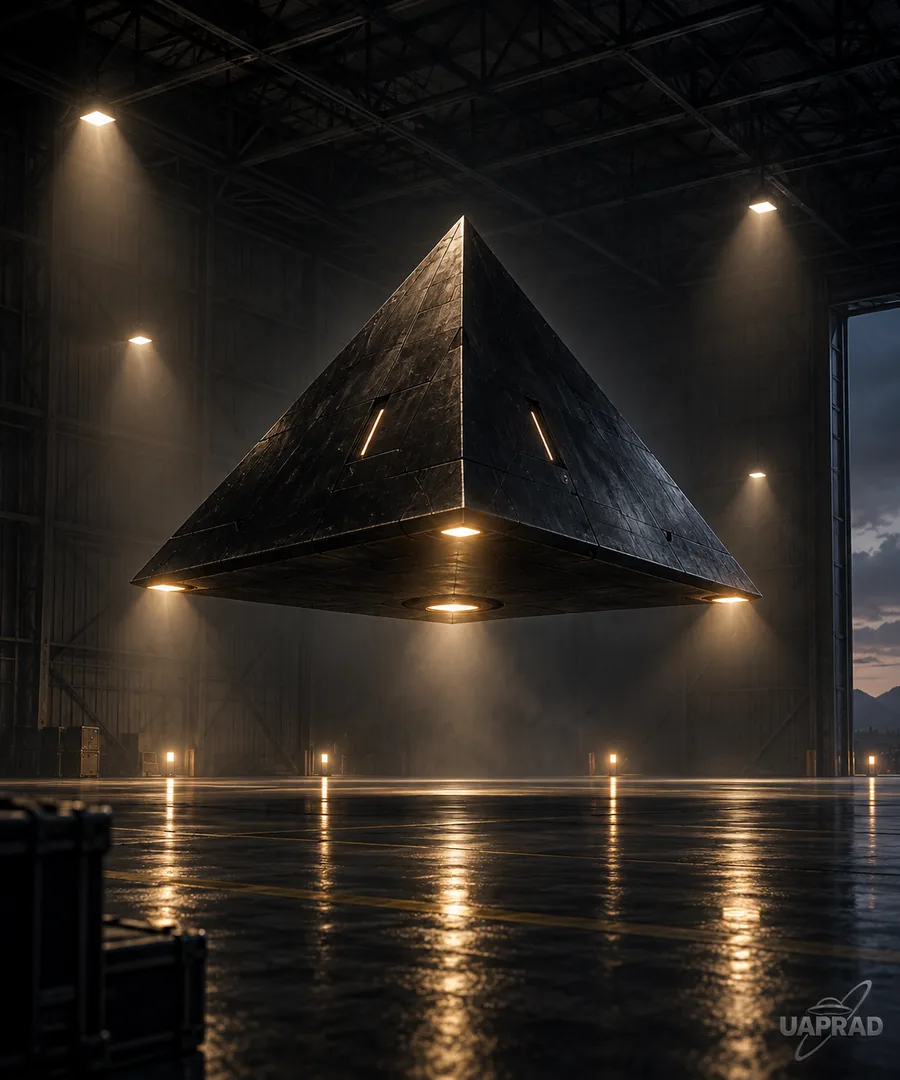
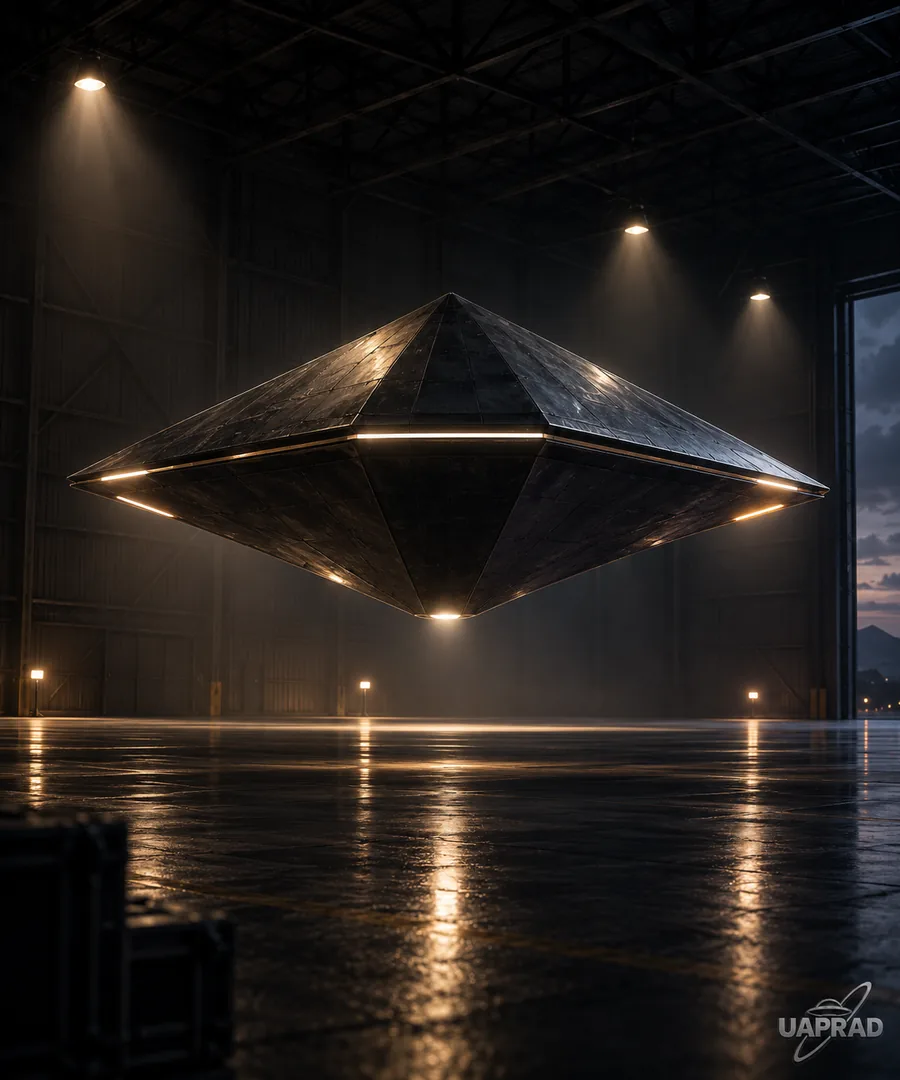
Triangle reports include dark bodies, delta or arrowhead forms and groups of three or more lights. These descriptions may refer to a solid object or to separate lights seen against a dark sky. Visible edges, surface detail or blocked stars provide the clearest distinction.

Reporting history

Reported descriptions

The stronger reports describe a dark triangle, delta or arrowhead with corner lights, a central light or visible underside. Slow translation, apparent hovering, low sound and large apparent size recur, principally in night observations.

Other reports establish only three lights in a stable or changing arrangement. Darkness between lights may be consistent with a body, but it is not direct evidence of one unless the witness also reports edges, star occlusion, surface illumination or another continuous-form cue.

Historical development

Triangular and delta descriptions occur in Project Blue Book-era files before ‘black triangle’ became a common popular label. Carmichael and Damon preserve early examples, although their measurements depend on witness estimation and the surviving records vary in detail.

The category became more prominent through the Belgian wave of 1989–90, the 1993 Cosford and Shawbury reports and the 2000 Illinois sequence. Later summaries can impose a standard giant-black-triangle image on materially different observations, so the earliest available wording controls the classification used here.

Contemporary reporting

The AARO comparison figures recorded on 14 September 2026 list 25 reports under ‘Triangle/Delta’, representing 4.2 per cent of entries with recorded morphology for 1 January 1996–15 August 2026. The denominator concerns reports with shape information, rather than all reports or a population of identified objects. Case-level records are needed to compare those labels with the historical examples discussed here. AARO reporting table

Report catalogue

Selected records describe reported appearances. Cross-listing one event under several forms adds no independent observation.

The catalogue distinguishes a visible triangular body from separate lights arranged in a triangle. Darkness between lights is recorded as an inferred silhouette unless a witness also described edges, a surface, an underside or blocked stars.

Triangle report catalogue

7 records
Case29 November 1989–April 1990 · BelgiumBelgian wave triangular-form reportsUnresolvedOfficial archival guide to the Belgian military record5 January 2000 · Southern Illinois, United StatesIllinois police-witness sequenceUnresolvedDirect witness submission3 September 1965 · Near Damon, Texas, United StatesDamon police encounterUnresolvedContemporary government case file
SummaryCivilian and police witnesses reported dark triangular or delta-like forms with corner lights, central illumination and slow or hovering movement. The Belgian Air Force statement documents the later F-16 response. Those radar contacts occurred separately and provide no evidence about the shapes described in the visual reports.Police witnesses at separated locations described a large, low and unusually quiet form moving across southern Illinois. Their accounts varied between triangle, arrowhead and house-like comparisons, but several included a coherent body rather than lights alone.Two sheriff’s deputies reported a large triangular object with a purple light at each end and a long blue light between them. The surviving Project Blue Book file preserves a close apparent-form report, but the estimated dimensions and distance were not independently measured.
Core evidence
Morphology confidence
Moderate
Physical form
Probable body in selected reports
Form
Triangle or delta with three lights in selected reports
Movement
Slow translation, hovering and rapid departure reported
Evidence
Witness statements, police records and military documentation
Limits
Strong morphology in selected reports; the series is heterogeneous
Morphology confidence
High
Physical form
Probable body
Form
Large triangle or arrowhead-like form
Movement
Low, steady transit with apparent acceleration in some accounts
Evidence
Independent witness submissions and dispatch chronology
Limits
Good multi-witness form evidence without measured range
Morphology confidence
High
Physical form
Probable body
Form
Triangular form with three principal lights
Movement
Approach and rapid departure reported
Evidence
Two witnesses and Project Blue Book documentation
Limits
Close apparent form; range and size remain estimated
Finding

Selected visual reports describe a coherent triangular form; the later radar episode is a separate evidence stream.

Separated police observations strengthen the event sequence and body description, although range and size were estimated visually.

Two deputies described the same triangular light pattern and body, with size and distance left unmeasured.

Case26–28 December 1980 · Rendlesham Forest, Suffolk, United KingdomRendlesham triangular-form accountsDisputedContemporary military memorandum31 March 1993 · Shropshire, United KingdomCosford and Shawbury reportsUnresolvedOfficial file reproduction23 June 1957 · Carmichael, California, United StatesCarmichael delta-form reportUnresolvedArchival reproduction of official case records
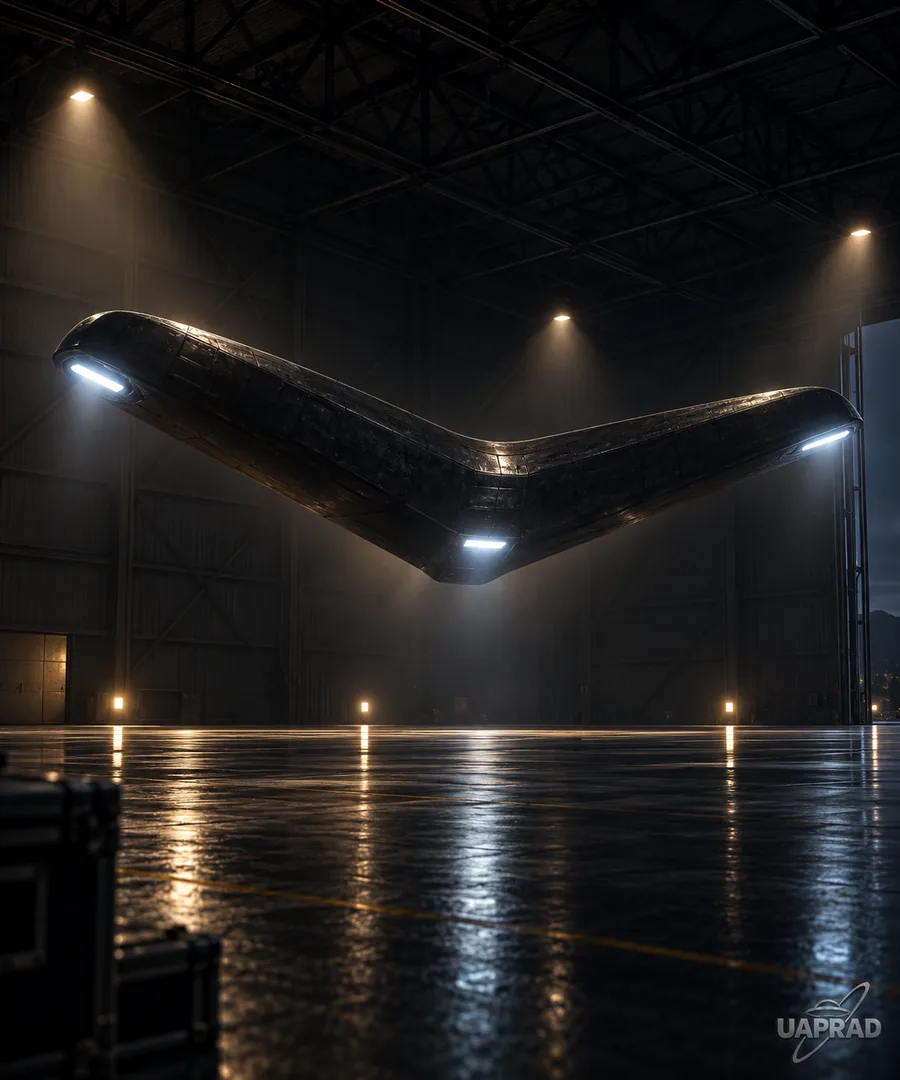
SummaryLieutenant Colonel Charles Halt’s memorandum of 13 January 1981 relays patrolmen’s description of a metallic triangular object with red and blue lights. Halt separately records later light observations that he witnessed. The early document therefore preserves a triangular-body claim, although its first paragraph is a report of others’ observations and its dates require comparison with the wider chronology.Reports collected during the wider March 1993 British sighting sequence included a large triangular object seen by a meteorological officer at RAF Shawbury. The Ministry of Defence file preserves official inquiry and competing explanations, but no calibrated image or measured range establishes the reported structure.A witness described a dark delta or boomerang-like form crossing the sky. Project Blue Book preserved the account and drawing. The brief observation contains no measured scale or reliable three-dimensional detail.
Core evidence
Morphology confidence
Moderate
Physical form
Indeterminate
Form
Triangular metallic appearance reported by patrolmen; lights in separate episodes
Movement
Stationary and moving lights across separate episodes
Evidence
Early military memorandum relaying testimony, later accounts and investigation
Limits
First-night form reported through Halt; later accounts require separate comparison
Morphology confidence
Moderate
Physical form
Probable body
Form
Large triangular form in the principal Shawbury report
Movement
Slow movement followed by apparent acceleration
Evidence
Witness reports and Ministry of Defence correspondence
Limits
Officially documented but without range or imagery
Morphology confidence
Moderate
Physical form
Indeterminate
Form
Dark delta or boomerang-like outline
Movement
Rapid transit
Evidence
Witness account, drawing and Project Blue Book material
Limits
Early documented form; one viewpoint and unmeasured range
Finding

A triangular-body description is present in the early memorandum; its attribution to patrolmen distinguishes it from Halt’s own later observations.

The Shawbury account provides the principal triangular description, supported by official correspondence; shape and scale rely on witness estimates.

The drawing preserves an early delta-like outline from one brief observation; scale relies on the witness estimate.

Case26 November 2019 · Villers-lès-Luxeuil, Haute-Saône, FranceVillers-lès-Luxeuil triangular-object reportUnresolvedOfficial unresolved case record
SummaryTwo motorists travelling in separate vehicles reported a dark triangular form near Villers-lès-Luxeuil. GEIPAN classified the case D1 but cautioned that the accounts were not entirely independent. Investigators examined documented Robin DR400 and Mirage traffic; timing, angular elevation and apparent size limited those matches. No photograph or measured object range survives.
Core evidence
Morphology confidence
High
Physical form
Probable body
Form
Dark triangular form
Movement
Steady overhead passage
Evidence
Two witness accounts and GEIPAN investigation
Limits
Related witnesses; aircraft hypotheses examined; range and size estimated
Finding

Two related accounts preserve a triangular appearance; partial dependence between them and imperfect aircraft matches limit physical interpretation.

Evidence

Images and video

Public imagery does not match the depth of the witness record. Night photographs and video commonly preserve lights without resolving the surface between them. The well-known Petit-Rechain photograph cannot support the Belgian wave because its maker acknowledged fabricating it years after the wider reports began.

A triangular image requires the same provenance and optical checks as other morphology evidence: the original file, exposure, focus, lens aperture, stabilisation and scene geometry. Three bright points can define a triangle in an image while leaving the number and physical relationship of the sources unresolved.

Sensor evidence

Radar can record a target’s presence, range or movement, but usually reveals little about its outline. The Belgian visual reports and F-16 radar episode occurred during the same wider wave; the radar contacts did not verify shapes reported on other dates. No triangle case in this selection combines clear structural imagery, independent range and a calibrated corroborating track.

Recurring characteristics

Night observation, three prominent lights, slow apparent movement and little or no sound recur across the category. Each feature also appears in conventional controls and is weakly diagnostic without range and body definition.

Continuous dark bodies are reported in the stronger cases but are absent from many triangle records. Reported size is usually inferred from assumed distance; corner-light and central-light arrangements vary too much to define a stable subtype.

Identification and interpretation

Identification problems

Aircraft and helicopters can present triangular light geometry, while several aircraft at different ranges can be grouped into one apparent structure. Lanterns and celestial patterns provide slower or stationary controls. Sound may be delayed, attenuated or masked when range is underestimated.

Visual completion can create a convincing edge or surface between separated lights. Autokinesis can also make a stationary light appear to move when reference points are absent. These mechanisms must be tested against each account rather than used as automatic explanations for all triangle reports.

Resolved and explained controls

These comparisons preserve the specific mechanism and confidence of each identification.

Triangle resolved and explained controls

2 records
Case20 October 2013 · Nantes, Loire-Atlantique, FranceNantes triangular-light controlResolvedOfficial resolved case record11 July 2024 · Pia, Pyrénées-Orientales, FrancePia three-light controlPlausibly explainedOfficial probable-resolution record
SummaryA triangular arrangement of lights was identified by GEIPAN as the Hyades star cluster. The case shows how a familiar celestial pattern can be perceived as a structured configuration when reference and orientation are poor.Three orange lights forming a triangle were assessed by GEIPAN as probably Thai lanterns. Their stable arrangement arose from separate drifting lights, showing why a triangular pattern need not mark the outline of one body.
Core evidence
Morphology confidence
High
Physical form
No bounded body
Form
Triangular light pattern
Movement
Apparent rather than physical motion
Evidence
Witness report and astronomical comparison
Limits
GEIPAN class A identification
Morphology confidence
High
Physical form
Separate conventional sources probable
Form
Three lights in triangular arrangement
Movement
Slow drifting movement
Evidence
Witness reports and GEIPAN investigation
Limits
GEIPAN class B probable lantern identification
Finding

The Hyades identification shows how fixed stars can be perceived as a triangular object in a dark sky.

The probable lantern identification provides a direct comparison for three drifting lights perceived as one triangle.

Research and analysis

Halt’s memorandum preserves an early triangular-body description through the patrolmen’s account. Its evidential function differs from a statement by Halt that he personally resolved that body. Later recollections should therefore be compared with the memorandum’s wording and attribution, while the light observations in its later paragraphs remain separate episodes. Halt memorandum (Paragraphs 1–3)

Villers-lès-Luxeuil shows why witness number and witness independence must be considered together. Two motorists supplied accounts, but GEIPAN cautioned that they were not entirely independent. Investigators found aircraft with partially compatible routes and lighting; discrepancies in timing, angular elevation and apparent size prevented a complete match. The unresolved classification reflects those remaining difficulties rather than the absence of conventional candidates. GEIPAN investigation

Continuous-body descriptions offer more information about perceived form than three lights alone. Their value increases when the record preserves how witnesses identified an edge or surface, and whether they did so before comparing accounts. Confidence in that description should remain separate from confidence in distance, dimensions or construction.

Aircraft and helicopters

Individual aircraft or formations can produce stable triangular lighting and apparently slow movement. A case-specific match requires compatible traffic, orientation, sound and timing.

Lanterns and celestial configurations

Separated lights can form a triangle without a connecting body. Wind, astronomical position and relative motion provide direct tests.

Unresolved bounded objects

Some reports contain continuous-body cues that are not reduced to light geometry alone. Their identity remains unresolved where range, imagery and independent measurements are absent.

A recurring triangular vehicle

Repeated geometry has encouraged a common-platform hypothesis, but the category combines bounded-body accounts, inferred silhouettes and resolved light configurations. No common material or calibrated signature links them as one vehicle class.

Evidence assessment

Triangular reports pose a question about the relationship between lights and a perceived surface. A stable arrangement of three points can be described without any connecting body; other witnesses report edges or an underside. Those accounts should be assessed by the features actually recorded, with the degree of darkness and the sequence of witness communication treated as part of the evidence.

Rendlesham’s early memorandum contains a relayed triangular description, while the Villers record contains two partly dependent accounts. Each supports a narrower conclusion than a simple count of witnesses or official documents suggests. The Belgian radar episode is another distinct evidential stream: its existence cannot supply the outline reported by witnesses on other occasions.

Resolved stellar and lantern configurations provide controls for light-only observations. Their explanatory reach is conditional on position and relative movement, and they leave continuous-body accounts requiring their own analysis. The selected cases preserve sufficient differences in shape detail, observation conditions and measurement quality to favour comparisons between particular reports over a uniform triangular vehicle model.

Research gaps

  • Original police, military and witness records for major regional waves.
  • Independent sight lines sufficient to reconstruct range and scale.
  • Calibrated imagery resolving the surface between lights.
  • Synchronous optical and radar tracking of the same target.
  • Historical database coding that separates bounded bodies from inferred light geometry.

Source library

The tiers describe each source’s relationship to the record. Direct testimony can remain uncorroborated, and an official document can preserve a claim without verifying its physical interpretation.
Tier 1 Primary records and testimony

Tier 2 Official and institutional records

Tier 3 Technical and critical analysis

Editorial record
Published Last revised Next review