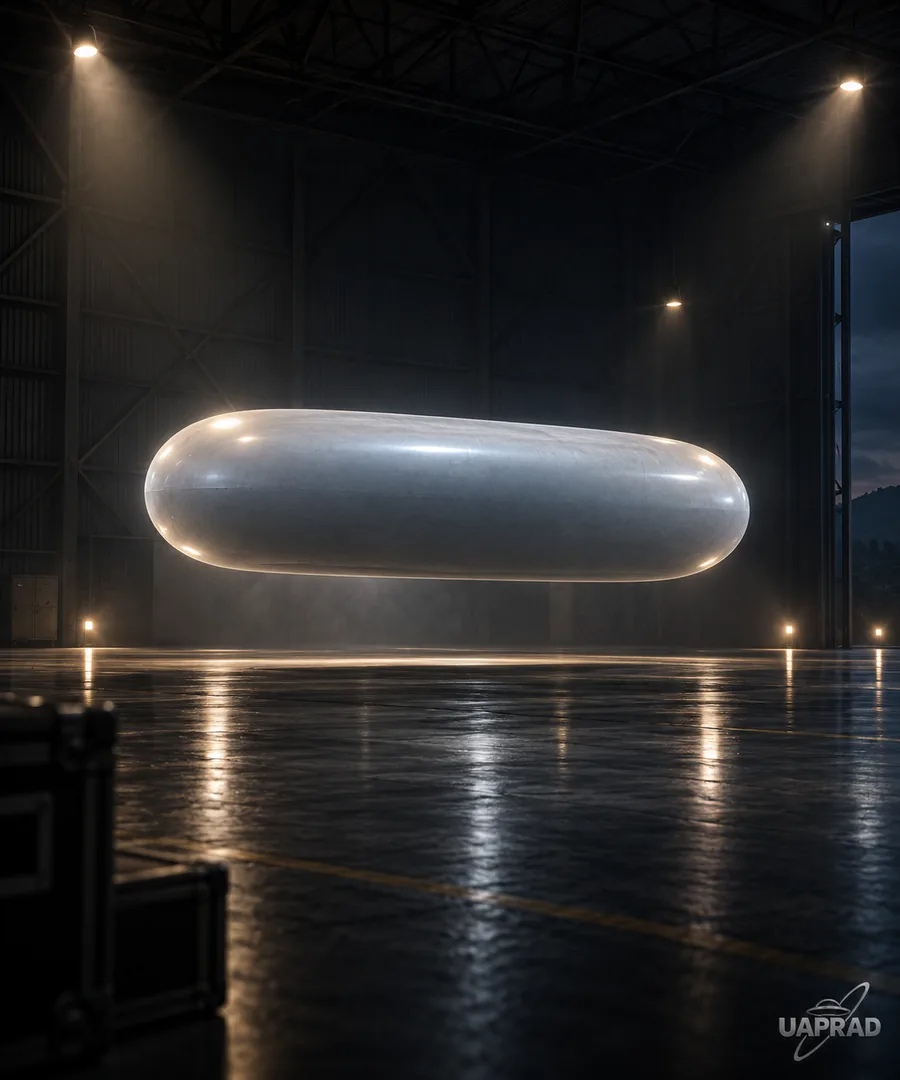
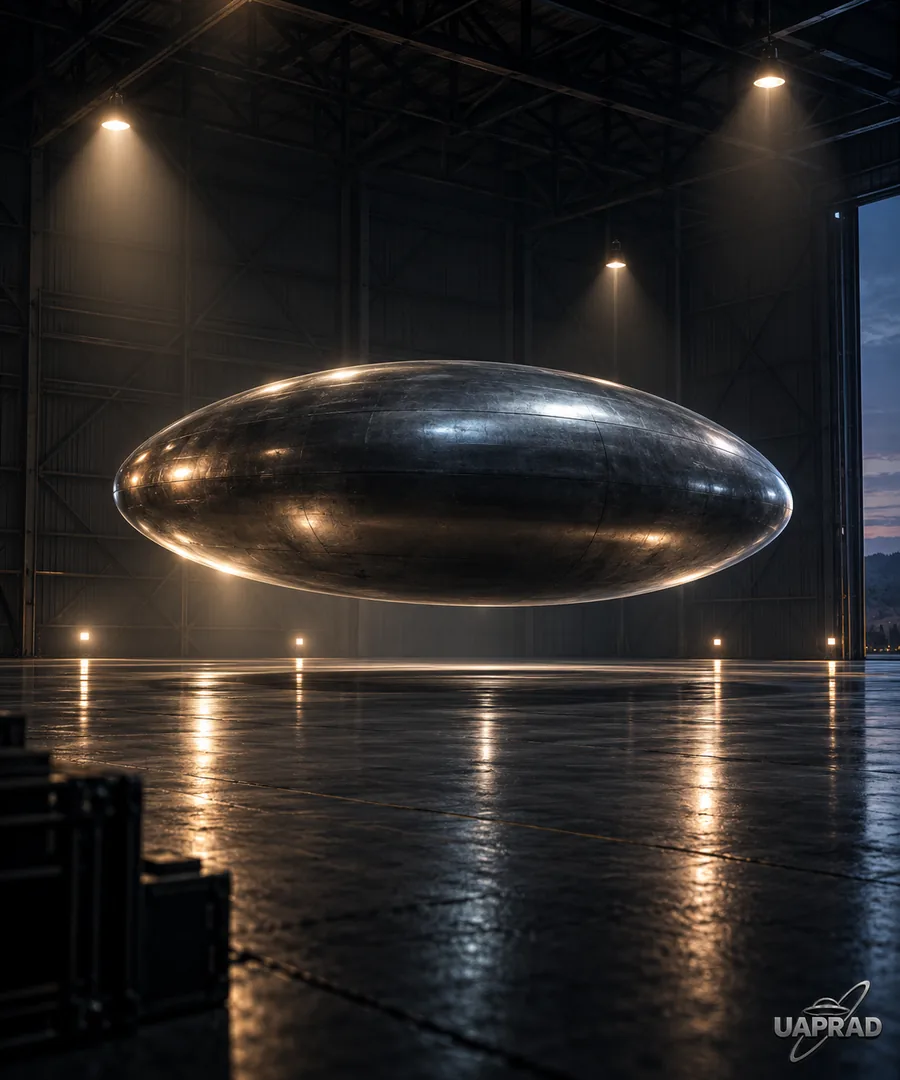
Cigar and cylinder reports use comparisons such as fuselage, tube, torpedo, rocket and bullet. Some witnesses describe a continuous body with visible ends or surface features. Other records contain a luminous streak, a line of lights or an elongated sensor image. Their shared feature is appearance, not necessarily cause.
Reporting history
Reported descriptions
Descriptions range from dark or metallic wingless bodies to luminous rods and objects with rows of window-like lights. Reported ends may be rounded, blunt or pointed. Straight translation is common, although some accounts include hovering, rapid passage or a trailing glow. Air Intelligence Report No. 100-203-79; Army Reserve report: Coyne helicopter encounter
Aviation witnesses can often describe traffic, visibility and flight conditions in detail. Their estimates of size and speed still depend on distance, which requires radar, triangulation or another measurement. Report on Aerial Phenomena near the Channel Islands
Historical development
Elongated descriptions appear in early Project SIGN and Project Blue Book records. The 1948 Chiles–Whitted encounter used fuselage and rocket-like comparisons, while the 1951 New Delhi file recorded cigar and bullet language. Project Blue Book Special Report No. 14 later retained ‘cigar shape’ as an explicit reporting category. Air Intelligence Report No. 100-203-79; Project Blue Book case file: New Delhi, March 1951
Later aviation reports used similar words for different observations. The Coyne helicopter crew described a close illuminated form. The Alderney witnesses saw sharply defined elongated lights at uncertain range. Recent official releases include elongated areas of infrared contrast. The original terms are retained because ‘cigar’, ‘rocket’ and ‘fuselage’ describe different shapes.
Contemporary reporting
The AARO comparison figures recorded on 14 September 2026 list 36 reports under ‘Cylinder’, representing 6.1 per cent of entries with recorded morphology for 1 January 1996–15 August 2026. The denominator concerns reports with shape information, rather than all reports or a population of identified objects. Case-level records are needed to compare those labels with the historical examples discussed here. AARO reporting table
Report catalogue
Selected records describe reported appearances. Cross-listing one event under several forms adds no independent observation.
The catalogue separates continuous bodies from lines of light and elongated sensor images. Alignment, blur, vibration and processing can create a long, narrow appearance even when the source is not cylindrical.
The uploader-defined title describes the target as ‘cigar shaped or fast spherical’. AARO identifies the source as likely military infrared imagery and states that the media was digitally altered before upload; the released file also contains slowed replays. The record preserves genuine morphology ambiguity and cannot distinguish physical outline from motion, optics and processing.
Two Eastern Air Lines pilots reported a fast, wingless and elongated object with a row of illuminated openings and a rearward flame or exhaust-like feature. A passenger reported a bright light but did not independently resolve the same structure.
Witnesses at a flying club described a metallic cigar or bullet-shaped object crossing the sky. The surviving Project Blue Book record card contains conflicting evaluation markings, including possible-balloon and unidentified indications; it should not be presented as an unqualified official unknown.
Core evidence
Morphology confidence
Low
Physical form
Unresolved sensor target
Form
Ambiguous elongated or round image; morphology comes from the uploader title
Movement
Brief rapid transit with slower replays
Evidence
Digitally altered derivative infrared video
Limits
Officially released; native imagery, range and full telemetry are not public
Morphology confidence
High
Physical form
Probable body
Form
Wingless fuselage or rocket-like body
Movement
Rapid reciprocal passage
Evidence
Two cockpit witnesses, passenger light report and official files
Limits
Strong pilot description; distance and dimensions estimated
Morphology confidence
Moderate
Physical form
Indeterminate
Form
Metallic cigar or bullet-like form
Movement
Rapid straight passage
Evidence
Witness reporting preserved in official file
Limits
Sparse record with conflicting evaluation markings
Finding
The altered file leaves the spherical and elongated labels used in its title equally uncertain.
Four Army Reserve helicopter crew members reported an elongated grey object approaching their aircraft and illuminating the cockpit with green light. The case retains a coherent close-range morphology, but later reconstructions differ on structure, distance and the reported change in altitude.
Commercial pilot Ray Bowyer reported two bright elongated objects, and a second pilot offered partial corroboration from another position. The technical study explored geometry and atmospheric-optics hypotheses, but uncertain range leaves physical size and precise form unresolved.
A witness retrospectively described a silent, dark elongated object observed during childhood. GEIPAN classified the case C because the delay and limited surviving information prevented a reliable investigation. It is useful as a documentation limit, not a strong physical-form case.
Core evidence
Morphology confidence
High
Physical form
Probable body
Form
Elongated grey form with reported forward and aft features
Movement
Approach, apparent hover and departure
Evidence
Four crew accounts, official report and later analysis
Limits
Strong multi-witness morphology without calibrated range
Morphology confidence
High
Physical form
Indeterminate
Form
Bright elongated or flattened forms
Movement
Little apparent motion during observation
Evidence
Pilot testimony, passenger reports and technical reconstruction
Limits
Strong apparent outline; range and scale remain model-dependent
Morphology confidence
Low
Physical form
Indeterminate
Form
Dark elongated form
Movement
Movement reported retrospectively
Evidence
Single retrospective account
Limits
GEIPAN class C; long reporting delay
Finding
Four crew members reported the same elongated form and cockpit illumination, while later accounts differ on structure and distance.
The long reporting delay leaves the shape dependent on one retrospective account.
Evidence
Images and video
Public images contain less shape detail than the strongest witness descriptions. Motion blur, infrared bloom, platform vibration, rolling-shutter distortion and visible trails can all stretch an image. Original files and sensor settings are needed to distinguish these effects from the source’s outline.
AARO resolved one Western United States recording as three distant commercial aircraft distorted by sensor vibration. PR053 remains unresolved and its public file has been altered. It cannot show whether the target itself was cigar-shaped or spherical.
Sensor evidence
No unresolved case in this selection combines visible ends or surface detail with measured range, calibrated views from several angles and a corroborating sensor track. Radar and air-traffic data can locate a target and trace its movement, but usually provide little information about shape. Images become more useful when the target contains sufficient detail and the recording process is documented.
Recurring characteristics
The recurring feature is elongation along one axis. Wingless appearance and straight movement are common, but resolved aircraft controls show that viewing aspect can suppress wings and tail. Window-like segmentation also recurs, yet the Pierrelatte control shows how a Starlink train can be perceived as one body with illuminated openings.
The category contains luminous transients, dark or metallic bodies and sensor-only contrast areas. Their duration, emission and context differ enough that they should not be treated as one subtype solely because each appears long and narrow.
Identification and interpretation
Identification problems
Aircraft viewed head-on, from behind or under strong backlighting can present mainly their fuselage. Meteors, atmospheric entries, contrails and rocket plumes can produce brief elongated forms, while balloons and aerostats remain relevant to slower observations. Each explanation depends on the reported duration, trajectory, illumination and environmental setting.
Perception can group aligned lights into one body and assign them a scale that the observation does not measure. Cameras introduce separate problems: motion blur, vibration, tracking and compression can stretch a compact source. A physically present target and an artefactual image shape can therefore coexist.
Resolved and explained controls
These comparisons preserve the specific mechanism and confidence of each identification.
Published 26 February 2024 · Western United StatesAARO Western United States sensor controlResolvedOfficial case resolution
Summary
A line of lights perceived as an elongated object with illuminated openings was identified by GEIPAN as a Starlink satellite train. The case demonstrates perceptual grouping: aligned points can imply one structured body when separation is not resolved.
A witness recorded an elongated luminous form that GEIPAN matched to a Vueling Airbus A321. Aspect and lighting suppressed the aircraft’s finer structure, leaving a fuselage-like profile. The case is a direct control for wingless appearance at distance.
AARO resolved an infrared recording as three distant commercial aircraft and attributed their distorted apparent shapes to sensor vibration. The case shows that physical targets can be present while the recorded elongation remains an imaging effect.
Core evidence
Morphology confidence
High
Physical form
Separate conventional sources
Form
Elongated form inferred from aligned lights
Movement
Steady linear transit
Evidence
Witness account and orbital reconstruction
Limits
GEIPAN class A identification
Morphology confidence
High
Physical form
Resolved conventional aircraft
Form
Elongated luminous profile
Movement
Flight-path movement
Evidence
Video and flight-data match
Limits
GEIPAN class A identification
Morphology confidence
High
Physical form
Resolved conventional aircraft
Form
Distorted elongated contrast areas
Movement
Compatible with distant aircraft tracks
Evidence
Imagery, flight data and sensor analysis
Limits
Official resolution attributes distortion to vibration
Finding
The Starlink identification shows how aligned lights can be perceived as one long body with illuminated openings.
The flight-data match shows how distance, angle and lighting can reduce an aircraft to a wingless elongated profile.
Flight data and sensor analysis trace the elongated images to aircraft distorted by platform vibration.
Research and analysis
An elongated appearance can arise at three different levels: an extended body, several aligned sources, or an instrument stretching one source. The controls in this catalogue isolate those alternatives. The identified airliner addresses suppressed wing detail; the Starlink example addresses grouping of separate lights; the AARO recording addresses vibration during imaging. They should be compared with the matching evidence channel in an unresolved case.
The aviation accounts retain descriptive detail that an unresolved infrared patch lacks, although observer expertise cannot determine a distance that was never measured. Where size is inferred from an assumed range, the apparent length should be preserved separately from the physical estimate. Rows of lights or window-like features also require evidence of a continuous surface before being treated as openings in one fuselage.
The unresolved cases consequently support a description of elongation more securely than a shared cylindrical structure. A useful reconstruction asks which details persist when range, viewing aspect and source grouping are varied within the limits of the record. Those are the variables that can distinguish a wingless-body hypothesis from a conventional source seen under poor contrast.
Aircraft and aerostats
Known aircraft can appear wingless or cylindrical when aspect, contrast and lighting suppress finer structure. A match still requires compatible traffic, trajectory and timing.
Linear lights and transient phenomena
Satellite trains, meteors, atmospheric entries and plumes can produce an elongated body impression without a persistent cylindrical object.
Sensor-produced elongation
Blur, vibration, bloom and processing can stretch an ordinary target in imagery. This explains the recorded shape, not necessarily the identity of every underlying source.
Unresolved elongated bodies
Some reports retain a coherent bounded-body description after obvious controls are considered. Their identity remains open because the public evidence does not determine construction, performance or origin.
Evidence assessment
Cigar and cylinder descriptions recur from early Air Force files to recent aviation and sensor reports. Chiles–Whitted and Coyne contain detailed multi-witness accounts of elongated bodies. Alderney adds observations from two aircraft, while New Delhi preserves an early official record with conflicting evaluation marks.
Range determines how much weight the reported dimensions can carry. In the principal unresolved cases, size, speed and proportion remain visual estimates. Recent infrared records present a different problem: vibration, blur and processing can stretch a compact target into an elongated image.
The controls isolate several routes to an elongated appearance: aircraft aspect, grouped satellite lights and sensor vibration. Detailed aviation accounts preserve more information about perceived outline than the selected unresolved infrared clips. Comparing the appropriate mechanism with each evidence channel is therefore more informative than assigning every long image or wingless description to one cylindrical object class.
Research gaps
Primary-file review for supporting Project Blue Book cases.
Reconciliation of the Coyne crew’s contemporaneous and later structural descriptions.
Calibrated multi-angle imagery resolving edges, ends and surface structure.
Independent range and trajectory reconstruction for aviation observations.
Controlled comparisons showing how aircraft, linear lights and sensor motion alter apparent form.
The tiers describe each source’s relationship to the record. Direct testimony can remain uncorroborated, and an official document can preserve a claim without verifying its physical interpretation.
AARO UAP Reporting Trends — Comparison figures recorded on 14 September 2026 for reports with recorded morphology. The table supplies labels and proportions, without case-level evidence of physical form or identity.
AARO Western United States case resolution — AARO identified three distant commercial aircraft and attributed their distorted recorded shapes to sensor vibration, providing a direct sensor-image control.
AARO / DVIDS: DOW-UAP-PR053 — Officially released sensor media and description. Officially released; native imagery, range and full telemetry are not public.