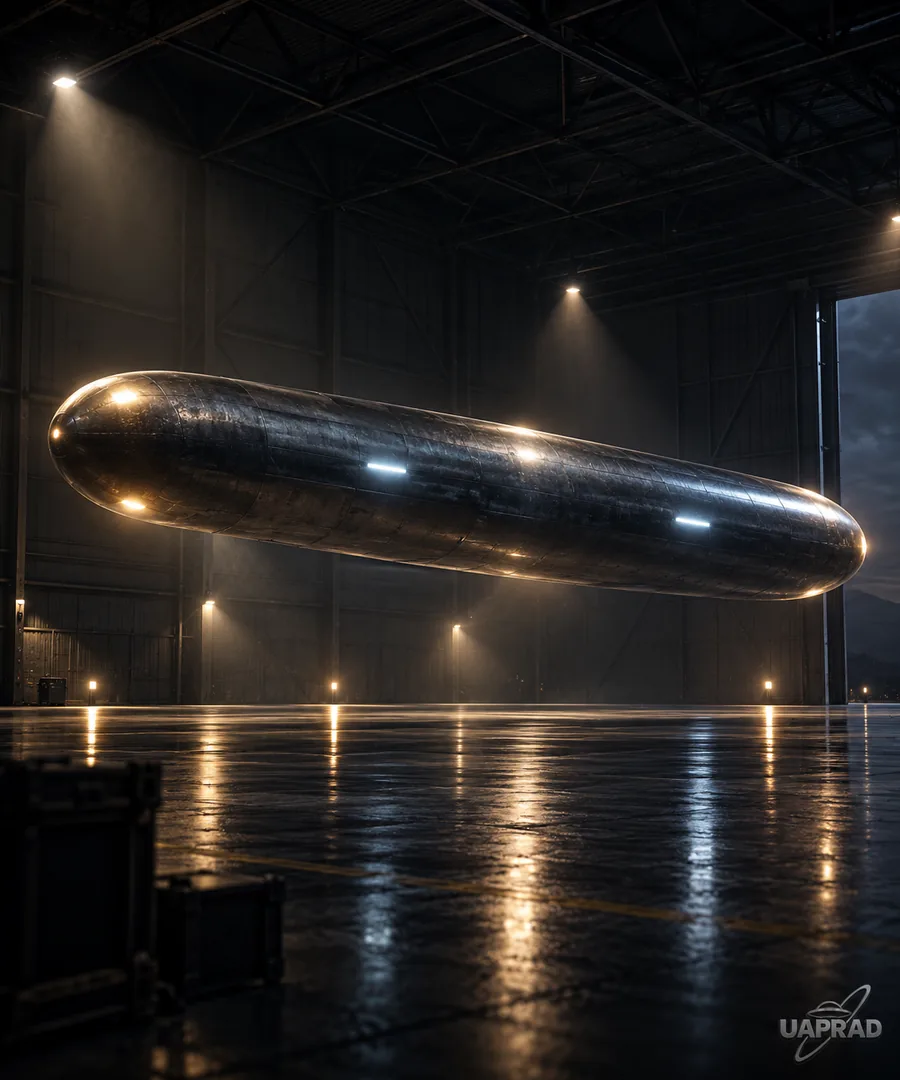
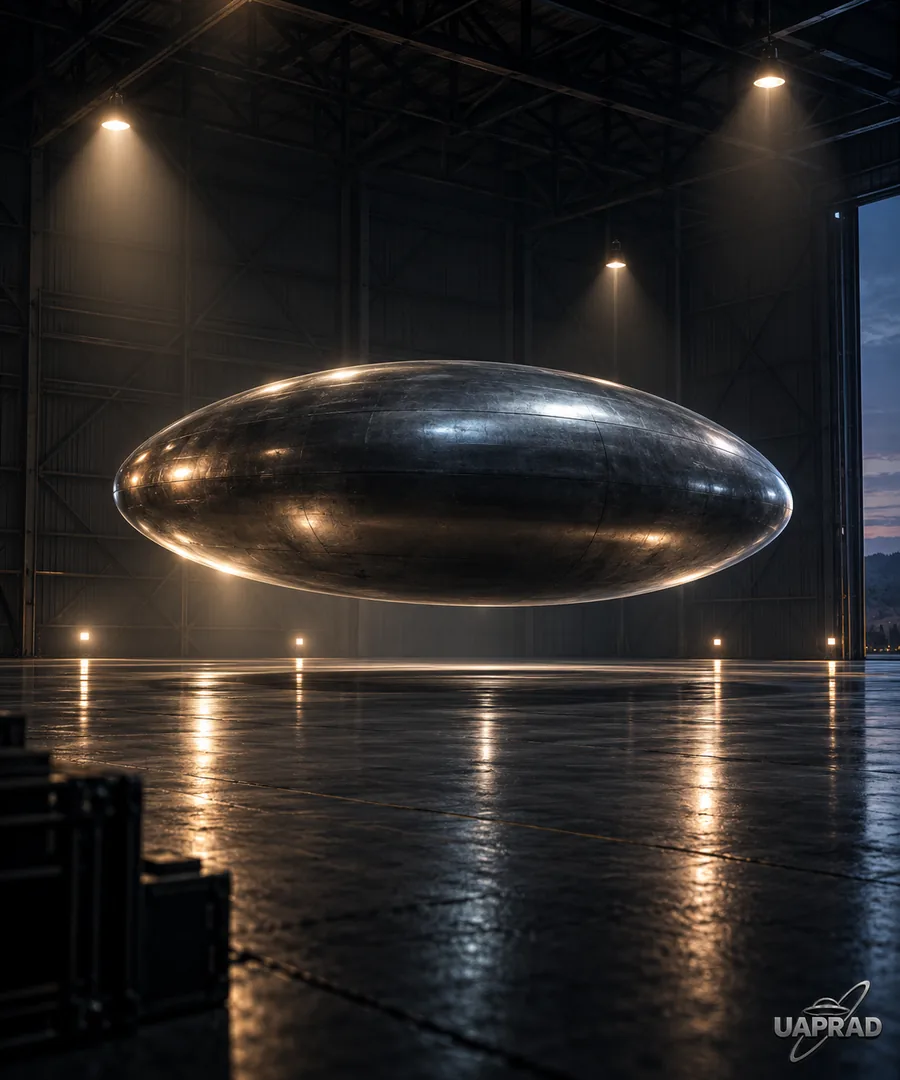
The capsule, or ‘Tic Tac’, label comes from the 14 November 2004 USS Nimitz flight, when aircrew described a smooth white oblong with no wings or rotors. The label records that description. It is not a class that can be extended to every featureless sensor image or every wingless elongated report.
Reporting history
Reported descriptions
Fravor wrote that all four aircrew saw a small white Tic Tac, aligned north–south and moving abruptly over white water, with no rotors, rotor wash or wings. He describes a climb towards his aircraft and a sudden departure at about half a mile. A controller then reported a track near the combat air patrol point, about 60 miles to the east, in under a minute. That last step is his reading of the controller’s call, not a released radar plot. David Fravor, written statement to the House Oversight Committee, 26 July 2023
The UAPRAD witness record for Dietrich corroborates the white oblong and the disturbed water, and her public account is more limited on performance and identity. The two weapons-systems officers are included in Fravor’s statement that all four looked down. Their own published descriptions of the shape are sparse.
Historical development
Smooth oblong descriptions are older than the Tic Tac name. The modern label became fixed after the November 2004 Nimitz training flights, then through interviews and the 2017 press reporting. This page uses Fravor’s written statement of 26 July 2023 as the principal shape record because it records his description in a congressional submission. It was given nearly nineteen years after the flight. Earlier interviews are not treated as a second observation.
The name is Fravor’s comparison with a Tic Tac mint, not a measured profile. Later retellings supply lengths that the written statement does not give. Any such length assumes a distance. The catalogue retains the shape words and treats the dimensions as estimates.
Contemporary reporting
The AARO comparison figures recorded on 14 September 2026 list 20 reports under ‘TicTac’, representing 3.4 per cent of entries with recorded morphology for 1 January 1996–15 August 2026. The denominator concerns reports with shape information, rather than all reports or a population of identified objects. Case-level records are needed to compare those labels with the historical examples discussed here. AARO reporting table
Report catalogue
Selected records describe reported appearances. Cross-listing one event under several forms adds no independent observation.
A report belongs here when the source describes a smooth, rounded, wingless oblong. A fuselage with windows, exhaust or a pointed rocket profile remains with cigar and cylinder. An infrared image is listed only where it is operationally tied to a capsule report, and it is treated as an unresolved image rather than a resolved body.
Capsule / ‘Tic Tac’ report catalogue
2 records
Case
14 November 2004 · Off southern California, United StatesUSS Nimitz visual encounterUnresolvedSworn witness statement
Commander David Fravor and Lieutenant Commander Alex Dietrich, in two F/A-18Fs from USS Nimitz, were sent by USS Princeton towards a radar contact. In a written statement on 26 July 2023, Fravor says that all four aircrew saw a small white Tic Tac over a patch of white water, aligned north–south, with no rotors, rotor wash or wings. The UAPRAD witness record for Dietrich corroborates a white oblong and the disturbed water, and it is more limited about performance. The close pass was brief, and the range was not measured.
A later Nimitz crew recorded an infrared target with an F/A-18 targeting pod. The clip was circulated in 2017 and later posted by DVIDS as Navy imagery. The released frames show a featureless infrared source. They do not resolve rounded ends, a smooth casing or the absence of wings. Fravor identifies the clip with the object seen earlier. The public file contains no range, and changes in sensor mode can imitate abrupt motion.
Core evidence
Morphology confidence
High
Physical form
Indeterminate
Form
Small white Tic Tac or oblong, with no reported wings or rotors
Movement
Abrupt movement over white water; a rapid departure is reported
Evidence
Fravor’s 2023 written statement and Dietrich’s corroboration of the oblong
Limits
Statement recorded nearly nineteen years later; range and length unmeasured
Morphology confidence
Low
Physical form
Indeterminate
Form
Featureless infrared target; capsule outline not resolved
Movement
Apparent motion depends on pod mode, zoom and aircraft geometry
Evidence
Officially posted infrared video
Limits
No public range or full metadata; link to the visual object is unmeasured
Finding
Two pilots describe a white, wingless oblong in daylight. The reported size, the sudden departure and the later radar association remain estimates and a controller’s call, not released measurements.
The recording is an infrared target from a later sortie. It leaves the capsule outline unresolved, and it does not by itself identify the earlier visual object.
No public daylight photograph or video shows the object described on the visual pass. The shape evidence for that pass is testimony.
FLIR1, the infrared clip posted by DVIDS, shows a compact source without a resolved outline. Changes of sensor mode, zoom and lock can make that source appear to jump. The frames cannot be read as a picture of a Tic Tac. DVIDS: FLIR UAP video
Sensor evidence
Fravor writes that the Princeton controller had watched objects descend from above 80,000 feet, linger near 20,000 feet and then climb. The aircraft were sent towards one contact, so the operational link he describes is part of the account. The raw radar is not public, and altitude, speed and continuity cannot be reconstructed from that testimony alone. Gimbal and GoFast, from later East Coast flights, are often discussed with Nimitz. Neither released video shows a capsule. Radar can place a target. It does not show whether that target was a smooth oblong.
Recurring characteristics
Within this selection, the capsule description is specific and mostly confined to one event: white or pale, smooth, rounded, and without wings, rotors or reported exhaust. Repetition across later interviews is not a second observation.
Featureless infrared targets are much more common than verified capsules. A smooth screen image is what an unresolved source often looks like, and that appearance is recorded separately from the daylight description.
Identification and interpretation
Identification problems
At a distance, an aircraft fuselage seen along its length, or caught in a brief reflection of the Sun, can look like a solid oblong while the wings fall below contrast. The Paris binocular report and the Émancé video are controls for that effect. Émancé was matched to an identified airliner. Paris was classed as a probable aircraft reflection, and no single flight was named. A control demonstrates a mechanism. It identifies a particular case only when the geometry and timing fit. GEIPAN case record: Paris, 20 May 2017; GEIPAN case record: Émancé, 14 September 2024
An observer in a turning aircraft can perceive a slower object as reactive. Without range, a small nearby body and a larger distant one can share an angular size. The Nimitz estimates of length, and of a 60-mile displacement, inherit that limit.
Resolved and explained controls
These comparisons preserve the specific mechanism and confidence of each identification.
Capsule / ‘Tic Tac’ resolved and explained controls
A witness recorded an elongated luminous form that GEIPAN matched to a Vueling Airbus A321. Aspect and lighting suppressed the aircraft’s finer structure, leaving a fuselage-like profile. The case is a direct control for wingless appearance at distance.
A witness watching a bright point through binoculars described a grey-silver oblong that seemed solid and metallic, with a darker circular area. GEIPAN classified the case B and attributed the oblong to a distant aircraft fuselage reflecting the Sun, with the wing seen edge-on. The observation lasted about 15 seconds and rests on one witness.
Core evidence
Morphology confidence
High
Physical form
Resolved conventional aircraft
Form
Elongated luminous profile
Movement
Flight-path movement
Evidence
Video and flight-data match
Limits
GEIPAN class A identification
Morphology confidence
High
Physical form
Probable conventional aircraft
Form
Grey-silver oblong that seemed solid, with a darker circular area
Movement
Little apparent motion during a 15-second look
Evidence
One binocular account and GEIPAN’s traffic geometry
Limits
GEIPAN class B; no photograph and no single identified flight
Finding
The flight-data match shows how distance, angle and lighting can reduce an aircraft to a wingless elongated profile.
Sun angle and viewing aspect can reduce a distant aircraft to a solid-looking oblong while concealing the wing planform.
Research and analysis
The Nimitz record contains two inference problems. The first concerns the distance and motion of the object seen by the aircrew. The second concerns continuity between that object, reported shipboard contacts and the target in the later infrared recording. A calculation can be internally consistent while still depending on an assumed distance or target association that the released record cannot independently secure.
Knuth, Powell and Reali model both reported encounters and the later infrared sequence. Their visual-departure calculation uses an estimated target width, assumed visual acuity and a modelled disappearance time. Their radar calculation uses Kevin Day’s reported altitude change and elapsed time; the authors acknowledge the absence of detailed radar data. Their infrared analysis assumes a physical target length to constrain range. These estimates are conditional on the reported quantities, geometrical choices and target interpretation. The paper provides no independent measurement of a capsule’s casing. Knuth, Powell and Reali (sections 2.4.1–2.4.3)
The aircraft controls show that a rounded wingless impression can arise from aspect and illumination. Their relevance is morphological; applying either identification to Nimitz would require a compatible object and encounter geometry. The current public record supports the aircrew’s reported capsule appearance, while leaving both the physical performance and the association between evidence streams open to further reconstruction.
Aircraft seen as a wingless oblong
The Paris and Émancé controls show how a real aircraft can present a wingless oblong. Using that finding for Nimitz would require a matching aircraft, position and timeline. The public record supplies no such match, and the aircrew reported no wings or rotors.
Separate sensor events in one operation
FLIR1 and the Princeton tracks belong to the same training period and the same operational response. Treating them as the same object as the white oblong is an inference from that context. The inference may be correct. It is not a continuous public track.
An unresolved smooth body
The daylight description is coherent across two pilots, in clear weather, over a visible disturbance on the sea. Origin, construction and performance stay open because distance was estimated and no image of that pass is public. Fravor’s conclusion, that the object outperformed his aircraft, is his judgement from the flight rather than a separate measurement.
A recurring Tic Tac vehicle
The AARO label and the fame of the 2004 flight have encouraged the idea of a repeated craft. This catalogue has one strong visual description, one unresolved infrared clip and two aircraft controls. Those records do not share a design, a material or a measured performance profile.
Evidence assessment
The Nimitz account supports a specific reported appearance more strongly than a general capsule category. Fravor’s retrospective written statement describes a white oblong observed by the aircrew, while Dietrich’s public account corroborates the broad shape and disturbed water with a narrower position on performance. The shared encounter provides valuable agreement, but the four people mentioned in Fravor’s statement cannot be treated as four independently published shape descriptions.
The principal analytical difficulty is continuity between evidence streams. The daylight observation, shipboard contacts and later infrared target belong to an operationally connected sequence, yet the public record does not provide a continuous measured track linking them. FLIR1 preserves imagery of a target whose detailed outline remains unresolved. Using the daylight description to determine that target’s dimensions, and then treating a performance calculation as confirmation of the daylight description, would make the inference circular.
The performance models are useful for identifying which quantities govern the result: target size, range, elapsed time and tracking interpretation. Their uncertainty calculations describe variation within the selected models; uncertainty over target association and sensor behaviour requires separate examination. Aircraft controls establish a route to an oblong impression under particular viewing conditions. The defensible conclusion is a well-defined witness description and an unresolved reconstruction problem, with no measured design common to a wider capsule population.
Research gaps
Contemporaneous statements from all four aircrew, set beside the 2023 written account.
Princeton radar tapes with calibration, timestamps and track continuity.
Sortie timing precise enough to connect or separate the visual pass and FLIR1.
Original targeting-pod metadata for FLIR1, including range and mode changes.
Any other AARO file labelled TicTac that can be compared with the Nimitz wording.
The tiers describe each source’s relationship to the record. Direct testimony can remain uncorroborated, and an official document can preserve a claim without verifying its physical interpretation.
FLIR1 UAP video — The infrared recording is from a later sortie. The released frames show a featureless target rather than a resolved capsule.
AARO UAP Reporting Trends — Comparison figures recorded on 14 September 2026 for reports with recorded morphology. The table supplies labels and proportions, without case-level evidence of physical form or identity.
NASA UAP Independent Study Team final report — NASA recommends calibrated sensors, preserved metadata and observations from more than one position before physical form or performance is treated as measured.