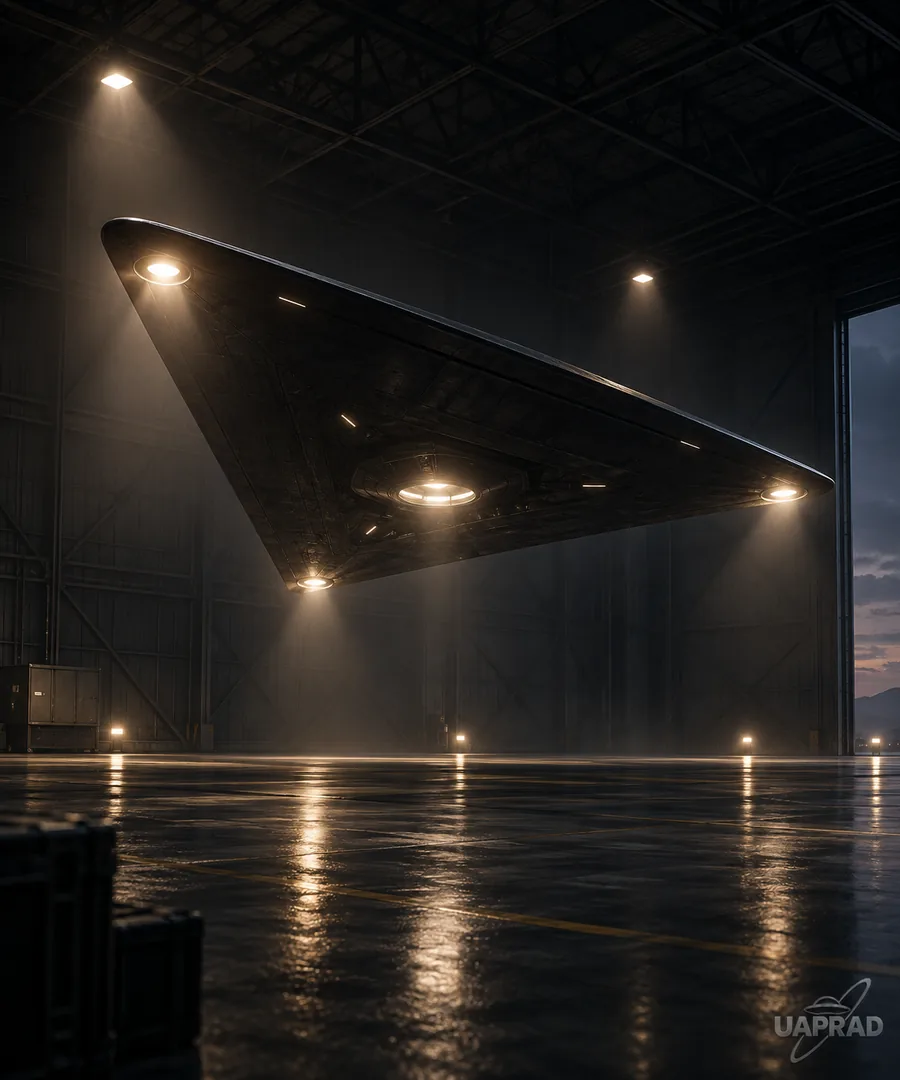
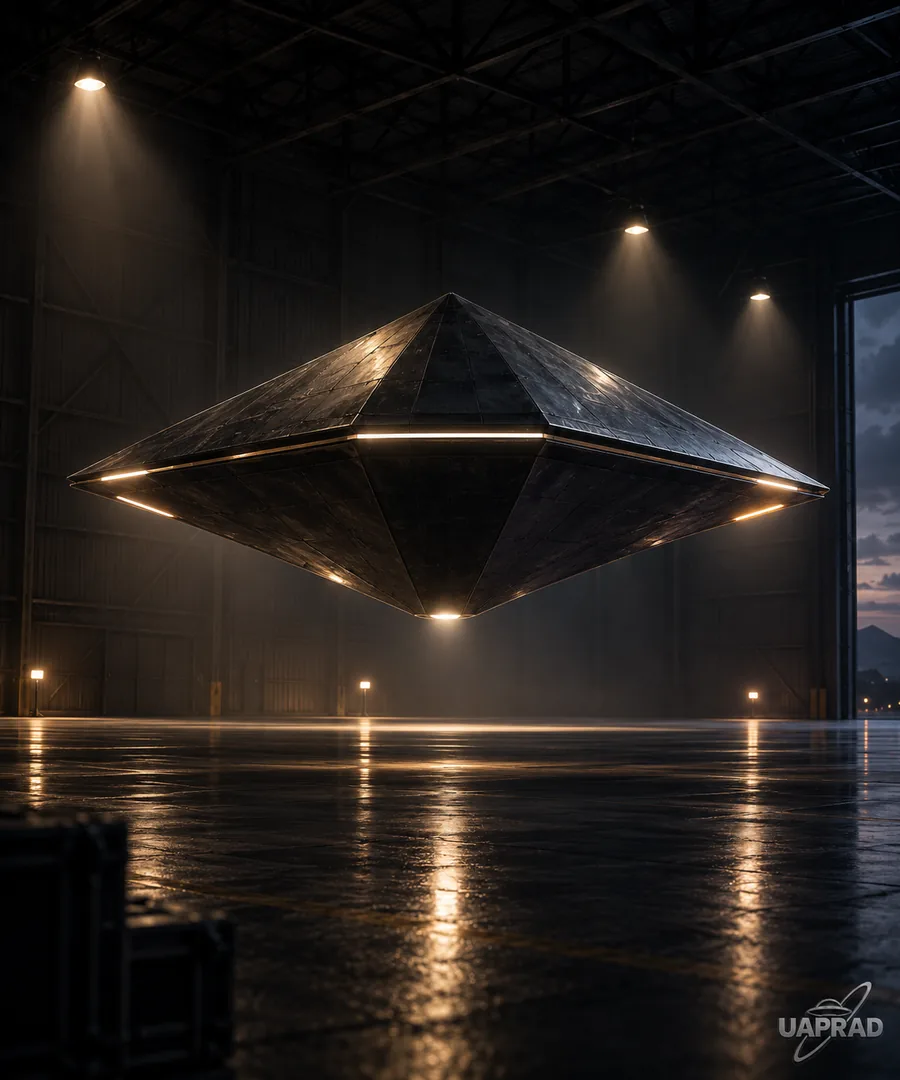
Pyramid claims feature in some recent images, but the documented case record is slight. Optical systems can render unresolved lights as triangles, creating an apparent pyramid without showing a three-dimensional structure.
Bodies and light configurations
The Lakeville submission uses a pyramid comparison for an apparently bounded object and reports a rotating upper feature. Its stated group of observers is recorded through one account; individual statements would be needed to assess agreement and independence. The rapid submission preserves the narrator’s description close to the event, while leaving range and three-dimensional geometry uncertain. Lakeville submission
The Douglas account describes a tower-like configuration, with stars reportedly visible between its lights through a scope. That detail weakens an interpretation requiring an opaque continuous surface. The event date is approximate and the account was submitted in 1998, several years after the reported observation. Those source conditions distinguish it from a prompt description of a solid pyramid. Douglas pyramidal-light report
The Navy optical explanation
At the May 2022 hearing, Deputy Director of Naval Intelligence Scott Bray attributed the triangular appearance in Navy night-vision recordings to the optical equipment. He described a reasonable correlation with unmanned aerial systems. The official explanation separates the shape imposed by imaging from identification of the underlying lights; a triangular frame alone supplies no depth information for a pyramid. House hearing transcript
A pyramid is a three-dimensional interpretation of faces meeting at an apex. A triangular patch or three-point arrangement provides only a projection. Evidence for the physical interpretation would need to preserve depth-related information, such as consistent changes across viewing angles, rather than relying on the familiar appearance of one frame.
Testing the apparent structure
The optical case supplies a relevant control for camera-produced triangles. Its mechanism should be tested with known lights through the same recording system, because focus and aperture conditions govern the resulting shape. A successful optical comparison explains the image boundary, while identification of the source remains a separate task.
For witness reports, the connecting surface is the discriminating feature. Stars seen through a configuration, an unresolved bright area and a reported opaque face describe different observations. Keeping those distinctions explicit prevents the category from absorbing every triangle into a presumed pyramidal vehicle.
Report catalogue
Selected records describe reported appearances. Cross-listing one event under several forms adds no independent observation.
Recorded before May 2022 · Off the coast of the United States
Navy night-vision triangle imagery
At the 17 May 2022 hearing, Deputy Director of Naval Intelligence Scott Bray said Navy personnel had recorded apparent triangles through night-vision goggles and a single-lens reflex camera. He attributed the triangular appearance to the optical system and said the lights were reasonably correlated with unmanned aerial systems.
The submission describes a light-brown pyramid with an illuminated underside and a rotating upper portion, and lists 25 observers. NUFORC publication establishes the submitted account, not independent corroboration of its estimates or physical interpretation.
Approximately 29 June 1994 · North of Douglas, Wyoming
Douglas pyramidal-light report
The submission, filed on 18 September 1998, gives an approximate June 1994 event date and lists three observers. It describes a moving tower-like arrangement of lights. One observer reportedly saw stars between the lights through a 20-power scope, favouring a light configuration over a visibly continuous body.
The selected records support three distinct descriptions: a witness-reported body, a tower-like arrangement of lights and a camera-produced triangle. Their superficial resemblance conceals differences in the evidence for a surface and depth. The Douglas scope detail is especially useful because visibility between the lights bears directly on continuity.
The control and the witness reports address different hypotheses. An optical explanation for the Navy recording tests how a camera generated an angular image. It cannot account for Lakeville’s reported surface without evidence that comparable viewing conditions applied. Equally, a witness’s pyramid comparison cannot overturn an equipment-specific explanation of another recording. A productive comparison would ask whether each record preserves an apex and connected faces through changes of viewpoint; that would move the discussion from a familiar shape word towards a constrained three-dimensional interpretation.
The Navy explanation gives a documented optical control, while Lakeville remains dependent on one published account of a larger group. No selected record supplies a testable reconstruction of a three-dimensional pyramid. The category’s value is consequently methodological: it identifies the extra evidence needed before a triangular appearance can support a pyramidal-body interpretation.
Research gaps
Separate statements from the Lakeville observers and any original drawings or imagery.
Native Navy recordings and optical-system details for controlled comparison of triangular images.
Cases and witnesses
Case deep dives
The report catalogue provides the available case material for this form.
Witness deep dives
The cited records identify the witnesses and the limits of the available testimony.
Public record
Official material, where available, is linked in the source library.
Source library
The tiers describe each source’s relationship to the record. Direct testimony can remain uncorroborated, and an official document can preserve a claim without verifying its physical interpretation.
Tier 1 Primary records and testimony
Navy night-vision triangle imagery — Scott Bray’s explanation in the 17 May 2022 hearing: triangular appearance attributed to the optical system, with lights reasonably correlated to unmanned aerial systems.
Lakeville pyramid report — Original database submission; observer counts and shape interpretations are reported by the submitter.
Douglas pyramidal-light report — Original database submission; observer counts and shape interpretations are reported by the submitter.