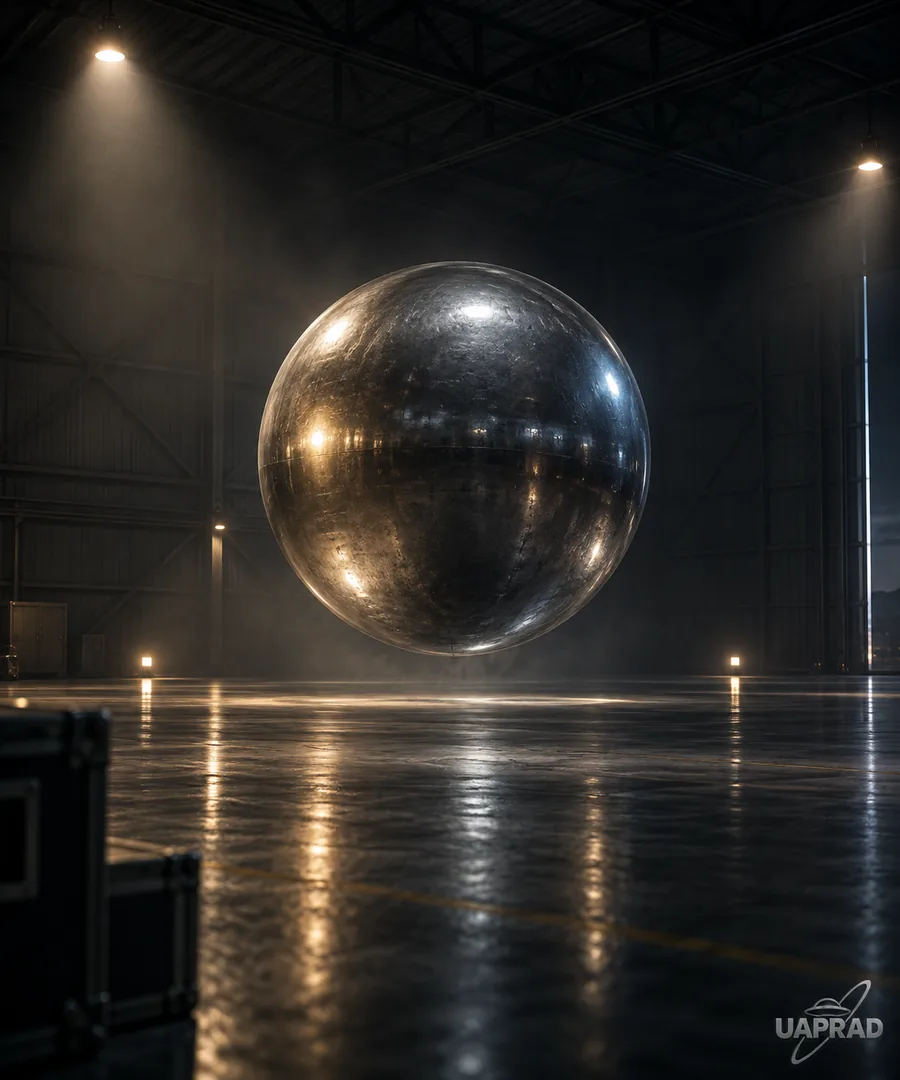
The cube-within-a-sphere description comes mainly from United States naval aviator reports during East Coast operations in the mid-2010s. The public record rests on testimony, with no released image showing the compound form.
Testimony and provenance
The compound description enters the congressional record through Ryan Graves’s July 2023 account of a squadron near miss. He describes another pilot seeing a dark cube inside a clear sphere at the entry to a training area. Graves’s experience with radar and infrared contacts supplies operational context, but the visual shape in this episode is relayed testimony. Identifying that relationship is essential to assessing how much detail the public record independently preserves. Graves’s written testimony (Printed p. 2)
The safety report mentioned by Graves would be valuable because it could preserve earlier wording, the observer’s position and the sequence of the encounter. The testimony documents that Graves reported such a record; the released statement alone cannot substitute for inspecting it. A later account repeating the same incident belongs to this evidential chain rather than constituting another sighting.
Visual and sensor evidence
A cube enclosed by a sphere is a more specific claim than either a dark target or a round image. Assessing it requires evidence about the inner boundary, outer boundary and their relationship. The absence of released imagery makes the description dependent on the account of the visual encounter. GIMBAL and GOFAST provide context for naval sensor observations but supply no image of the reported compound form.
Radar contacts and infrared detections may indicate objects in an operating area without identifying the target of a particular near miss. Continuous timing and location information would be needed to connect those observations. Similar surroundings and shared squadron experience give a reason to investigate a connection, while leaving target identity and morphology as separate questions.
Geometry and identification
The enclosing sphere could represent a reported physical boundary, an optical impression or a later interpretation of a brief view. A proposed explanation must account for both the dark inner form and the apparent enclosure under the encounter’s actual viewing conditions. General references to glare, balloons or radar reflectors provide candidate mechanisms; without a matched object or reconstruction they remain hypotheses.
The distinctive description is therefore useful as a research question. It supplies features that an explanation must address, but a highly specific verbal comparison does not automatically make the object’s construction equally specific. The testimony’s aviation-safety significance can be assessed independently of whether its physical form is eventually identified.
Report catalogue
Selected records describe reported appearances. Cross-listing one event under several forms adds no independent observation.
2014 operational period; testimony 26 July 2023 · Warning Area W-72, off Virginia Beach, United States
East Coast near-miss description relayed by Ryan Graves
Graves recounts another pilot seeing a dark cube inside a clear sphere during a near miss. The statement places the episode in squadron operations and mentions a safety report. It supplies no public image of the compound form or separately recorded statement from that observer.
The public record preserves a specific compound-form claim through testimony about another pilot’s observation. Its principal evidential limitation concerns access to the original visual account, rather than the precision of the familiar cube-and-sphere illustration. The operational context makes the incident relevant to aviation safety while leaving the construction and identity of the reported object open.
The specificity of the description makes the missing original account especially consequential. Evidence for an outer boundary alone would support a spherical appearance; evidence for a dark interior alone would leave its geometry open. The compound claim requires the observer to have resolved both boundaries in their stated spatial relationship. An earlier safety report could establish when those details entered the account and how they were expressed, while independent imagery or a separate observer’s statement would address corroboration. Those contributions should remain distinct when judging whether the account has become better documented or physically better constrained.
The morphology cannot be transferred to other East Coast tracks simply because they occurred in the same operational setting. A shared classification would require evidence connecting those targets and preserving the compound boundaries. Until that material is available, the category is a focused index to the reported near miss and the documents needed to assess it.
Research gaps
The contemporaneous squadron safety report and separately recorded descriptions from the near-miss aircrew.
Timing and location information capable of connecting the near miss to specific sensor tracks.
The tiers describe each source’s relationship to the record. Direct testimony can remain uncorroborated, and an official document can preserve a claim without verifying its physical interpretation.
House UAP hearing transcript, 26 July 2023 — The transcript places Graves’s morphology account within the questions, qualifications and aviation-safety evidence heard by the committee.